Showing posts with label Judaism. Show all posts

Tuesday, December 11, 2012

The complexity of marriage law - update

Legal (permitted by law and recognised by the state):
  • Opposite-sex church weddings (couple legally married and registered)
  • Same-sex civil partnerships in a register office / registered premises for weddings
  • Opposite-sex marriages in a register office / registered premises for weddings
  • Religious civil partnerships (civil partnership ceremonies in a religious building)

Being made legal soon:
  • Same-sex weddings in register offices and those churches & synagogues that want to do them (couple legally married and registered)
  • A transsexual person married to a person of the opposite sex to their original sex wanting to change their birth certificate to reflect their new sex will no longer have to divorce their partner (because when same sex marriage is legal, they can stay married).
  • A transsexual person civilly partnered to a person of the same sex will be able to change / "upgrade" to a marriage (8.5 on page 27 of the consultation outcome document)
  • Pagan same-sex handfastings in Scotland

The new arrangements for trans people are still not very satisfactory, as the conversion from one type of legal recognition to another will cost them money. This is particularly annoying for people who have already had to change their relationship status under the previous arrangements.

Not forbidden by law, but not recognised by the state
  • same-sex blessings in a church / synagogue
  • Pagan handfastings (weddings) in England & Wales
  • Blessings of polyamorous relationships
  • Humanist weddings - both same and opposite sex
Illegal (not permitted by law):
  • Opposite-sex civil partnerships in a register office / registered premises for weddings
  • Marrying more than one person

Legal (permitted by law and recognised by the state) in Scotland only:

Friday, September 07, 2012

What's wrong with the Incarnation?

Many Christians think that other religions don't like the idea of the Incarnation because they're offended by the idea of God becoming human.

The thing that is specifically offensive about the idea that Jesus is the only way to God is the idea that stems from it that all other religions are wrong, and that unless you have "accepted Jesus as your personal Saviour" you will go to hell. So according to this insane and offensive theology, that means Gandhi and other great luminaries are in hell.  (Then there's penal substitution theology, which is also offensive, but that is a separate issue.)

I don't have a problem with the idea of Jesus being divine. I do have a problem with the idea of his being the one and only incarnation of the godhead. As far as I'm concerned, we are all divine.

In polytheist religions, the idea of humans becoming divine, or the divine becoming human, crops up frequently. There's Krishna, who is an incarnation of Vishnu. There's Oưinn, who is either a deified human or a god who became human. There's Aradia, who was Diana's daughter and came to earth to teach Tuscan witches their craft, and how to resist oppression. There are many, many deities who became human, and humans who became deities. So the idea that other religions have a problem with the Incarnation because they don't like the idea of God becoming human is laughably ignorant.

In Judaism, the soul has three components - the nefesh (the animal soul, which disperses at death), the neshamah (the divine part, which returns to God at death), and the ruach (the breath of God, which gives life). The more spiritually developed you are, the greater the neshamah becomes. When Jesus told his disciples that he would send his ruach (his Holy Spirit) to be with the disciples at death, he meant he would send that component of his soul to be with them. This insight must have got lost in the early centuries of Christianity when the Judaic elements were eradicated from Christianity by opponents of "Judaizing".  Anyway, the point here is, that in Judaism, everyone is a child of God, and has God within them. (For more on this, see my earlier post, The Trinity and Jewish theology).

In the Religious Society of Friends (the Quakers), they say that everyone has "that of God" within them, and refer to the Inner Christ or the Inner Light. The idea is to uncover that light (not hiding it under a bushel) and let it shine.

In Unitarianism, which rejected the doctrine of the Trinity back in the 16th century, the view is usually that everyone has the Divine within them, too. James Martineau, a great 19th century member of the tradition (who actually identified as a Free Christian), said:
The incarnation is true, not of Christ exclusively, but of Man universally, and God everlastingly. He bends into the human to dwell there; and humanity is the susceptible organ of the divine.
What a truly great concept - the incarnation is true of all humans. Or as Shakespeare (religious beliefs unknown) so memorably put it:
What a piece of work is a man, how noble in reason, how infinite in faculties, in form and moving how express and admirable, in action how like an angel, in apprehension how like a god! the beauty of the world, the paragon of animals

Hamlet, Act II, Scene II
In Buddhism, we all contain the potential to become enlightened, to become a Buddha, to become divine. We are all Future Buddhas.

In Eastern Orthodox Christianity, although they believe that Jesus is the one and only divine incarnation, they also have the concept of theosis, which means that because Jesus opened the way between the human and the divine, we can all become divine. Indeed, Jesus himself said, "I have said, ye are gods."

So, no, the thing that annoys people about the Incarnation is not the idea that God became human - it's the idea that it only happened once.

Everyone has "that of God" within them - the neshamah, the ruach, the seed of a Future Buddha, the potential for theosis.


Monday, April 23, 2012

Support marriage equality

Now is a good time to write to your local county councillors to ask them to support marriage equality.

Here is the letter I have written to my local councillors:
I am writing to ask you to support marriage equality in Oxford County Council.

Thanet has become the first local authority in the UK to endorse the government’s proposals for marriage equality.

Some county councils have not yet made available information on how churches and synagogues that wish to do so can register for religious civil partnerships, and the registration fee is higher than for registering as a marriage venue. Please could you lobby for Oxfordshire County Council to do this.

In addition, I want to see marriage equality in the UK, and would hope that Oxfordshire's county councillors would support this. I want to see religious same-sex marriage made available for those religions and denominations that wish to perform these ceremonies (namely Unitarians, Liberal Judaism, Reform Judaism, Quakers, and the Metropolitan Community Church). Pagans would also like to be able to perform same-sex marriages, but as Pagan opposite-sex weddings have no legal standing in England and Wales, the nature of the obstacle to Pagan same-sex weddings is more complex.

Please also support the option for same-sex civil marriage and opposite-sex civil partnerships. This is important as many same-sex couples would like the opportunity to be married, and many opposite-sex couples would prefer the less traditional option.

This is also important for transgender people, who may be in either a civil partnership or a marriage currently, and in order to register as the opposite sex to the one they are currently labelled as, would have to divorce their partner and get either a civil partnership or a marriage.
The background to this is that Thanet County Council has endorsed the government's plans.
Thanet has become the first local authority in the UK to endorse the government’s proposals for same-sex marriage. Please ask your councillors to pass a motion supporting same-sex civil marriages & opposite-sex civil partnerships. Find out your local councillors & email them via this website: www.writetothem.com

BBC report 

Pink News report 
Please ask councillors to support same-sex marriage for those religions who want to do same-sex marriages too.

Tuesday, February 28, 2012

Missing the point (again)

PZ Myers and most of his commenters appear to have completely missed the point of Religion for Atheists.

They also completely exaggerate the importance of belief in religions. Alain de Botton is right that whether or not God exists is a boring question. It's been pretty well settled that God does not exist. Some theologians have got round this problem by saying that this is because God is existence, or the Ground of All Being, but then that leaves the question of what that might mean.

I'm glad that the New Atheism has raised the stakes in the theological game, and brought non-realist and apophatic theology to the fore again, but I dislike the way some New Atheists dismiss all religion as harmful rubbish.

Most religions are centred around practice rather than belief. In Hinduism, Paganism, Buddhism, Taoism, Unitarianism, Quakerism and Judaism, belief is not central to whether you count as a member of the religion or not. What counts is either values or practices. The question for Jews is not "Do you believe?" but "Are you observant?" For Pagans, what counts is your attitude to nature, the earth, and/or the land. There are many different schools of thought in Hinduism, Taoism, Paganism, Buddhism, Taoism, Unitarianism, and Quakerism, ranging from theists to non-theists. For Buddhists, deities may well exist, but they are irrelevant. Many Pagans and Unitarians would agree with the Buddhists on this. Many Unitarians are atheists and humanists.

So if it is not about providing an explanation of how the world works or how it came into being, what is religion for? It is about providing a system of shared meaning, and a set of spiritual practices (meditation and ritual), and a community to share ideas, joys and sorrows.

In liberal religions, you don't need to sign up to a set of axioms or propositions which may offend against your reason in order to be part of the community and make use of a collection of stories, mythology, symbols and practices.

Religious community also inspires people to band together to create social justice (although non-religious groups do this too). By consistently encouraging members to treat others with compassion, religious community can be a powerful tool for creating change. Think of Martin Luther King, Mahatma Gandhi, and others who were inspired to change the world.

Tuesday, February 21, 2012

The woman caught in adultery

Christ with the Woman Taken in Adultery, by Guercino, 1621 (Dulwich Picture Gallery).
Apparently Prof Richard Dawkins likes the story of Jesus and the woman taken in adultery.
[Richard Dawkins] made the broad and uncontroversial point that the Bible includes passages both laudable and vile. As an example of the former and a great teaching he thought most people in the room would immediately get behind, he gave the Gospel injunction, ‘he that is without sin, cast the first stone’.

Alex Gabriel is a bit baffled by this:
Of course literal stonings are undesirable, and of course reacting to transgressions overharshly is worth discouraging. But the point of what Jesus says is, he is without sin. Not being subject to paternally transmitted original sin, Jesus is the only completely sinless human being and was (to commandeer a phrase) born that way. This is what gives him moral authority, as the son of God, over the woman; it’s why only he gets to absolve her sins. When he tells the crowd, ‘You are not without sin’, he is telling them they don’t get to judge her.
Here's the story from the English Standard Version:
but Jesus went to the Mount of Olives. Early in the morning he came again to the temple. All the people came to him, and he sat down and taught them. The scribes and the Pharisees brought a woman who had been caught in adultery, and placing her in the midst they said to him, “Teacher, this woman has been caught in the act of adultery. Now in the Law Moses commanded us to stone such women. So what do you say?” This they said to test him, that they might have some charge to bring against him. Jesus bent down and wrote with his finger on the ground. And as they continued to ask him, he stood up and said to them, “Let him who is without sin among you be the first to throw a stone at her.” And once more he bent down and wrote on the ground. But when they heard it, they went away one by one, beginning with the older ones, and Jesus was left alone with the woman standing before him. 10 Jesus stood up and said to her, “Woman, where are they? Has no one condemned you?” 11 She said, “No one, Lord.” And Jesus said, “Neither do I condemn you; go, and from now on sin no more.”]]
Now, we could view Jesus entirely as a fictional or mythological character presented by the gospel authors - there is good reason to think that he acquired several legends from other mythological characters, in much the same way as King Arthur and Robin Hood did. Certainly the virgin birth story is as old as the hills, and was told about several Middle Eastern vegetation gods (Attis, Adonis, etc). The same goes for the story of the resurrection.

Or we could view him as a real person who has been at least partially misrepresentedby the gospel authors.

The mainstream Christian view is of course that he was the Son of God, in which context Alex's interpretation may well be correct.

Whether we view him entirely as a fictional character or as a real person at least partly misrepresented by the gospel authors, there are two questions we could ask here:
  • What does Jesus mean by "Let him who is without sin among you be the first to throw a stone at her.” and "Neither do I condemn you"?
  • What does the gospel author think he meant?
Alex argues that Jesus chooses not to condemn the woman because he believes that he has the authority to forgive her because he is without sin, because he is the son of God. Now, the Gospel of John comes from a different Christian tradition than the other three gospels; it is a gospel of signs and wonders, highly symbolic and allegorical, and constantly emphasising the author's belief that Jesus was the Messiah.  But remember, in Hebrew tradition, 'messiah' (anointed one of God) and 'son of God' meant two different things. The gods of other nations were sometimes referred to as the sons of God, and so was Satan (see the Book of Job); and Jesus never referred to himself as the Son of God, only as the Son of Man (which means something like "everyman" or "average bloke").  Not all early Christians believed that Jesus was part of the Godhead ("very God of very God" as Orthodox Christian liturgy puts it). Some were Adoptionists (they believed that God adopted Jesus as his son when he was baptised in the River Jordan); others were Arians, who believed that Jesus was conceived by the union of God and Mary, but that he had not co-existed with God from the beginning of time). There was a bewildering variety of opinions on this, some of which still survive: the Monotheletes, the Monophysites, Diaphysites, and all manner of variations. So the author of the gospel may not have thought that Jesus was part of the Godhead, though he or she did think that he was the Messiah and the Son of God - the doctrine of the Trinity was not finally settled till the Council of Nicaea in 352 CE, and the doctrine of Christ's nature was not settled till the Council of Chalcedony in 451 CE.


Why do I care about this if I think Jesus may well have been a fictional character? Because I like the story, and I think it's important to be able to interpret stories in a poetic and flexible way, but not to infer the author's intentions from later interpretations.


So here is my interpretation of the story.


Jesus comes (as a rabbi among other rabbis) to the temple. He is teaching the people (as a popular rabbi would) when the woman taken in adultery is brought to him. The punishment for her "crime" is a horrible, slow and painful death. Jesus points out that the people who want to kill her for it are also guilty of some misdemeanour or other. The story is silent on whether Jesus thinks he himself is without sin - perhaps the reader is meant to infer that, but it is not explicitly stated. The point of the story is that we should show mercy and not excessively punish people for their bad behaviour, because we have also behaved badly. It's about showing empathy to others.

When Jesus says "Let him who is without sin among you be the first to throw a stone at her.” and "Neither do I condemn you", I do not think that he's claiming to be without sin himself - that is a later doctrinal position.


OK, so elsewhere Jesus is reported as having said "Therefore be ye merciful, even as your Father in heaven is merciful" and "Judge not, that ye be not judged". But as far as I can recall, Jesus never arrogates to himself the right to judge. This power is attributed to him later by the Book of Acts and the Book of Revelations.


In fact, Jesus repeatedly extends sonship of God to humans generally. He says "I have said, ye are gods" and refers to God the Father as the father of everyone, not just his own father. So I don't think that Alex's interpretation is justified either by the text, or by the state of Christian theology when the text was written. It may well be the view of later theologians, but that is another issue.


So I think Richard Dawkins is right to like the story. He likes it because it's about being reasonable and empathic, tempering justice with mercy, and taking all factors into consideration, and not being judgmental and self-righteous.

What do you think the story means?

Thursday, September 29, 2011

A hopeful sign

I was delighted to see that, in Scotland, the Unitarians, Quakers, Metropolitan Community Church, the Pagan Federation and Liberal Judaism are backing members of the the Scottish Youth Parliament in the campaign for same-sex marriage.

In England, the campaign for religious civil partnerships brought together the Unitarians, Quakers, Metropolitan Community Church, and Liberal Judaism - but sadly did not include the Pagan Federation. The issues surrounding marriage for Pagans in England (whether same-sex or opposite-sex) are slightly more complicated, in that Pagan celebrants are not licensed to perform opposite-sex marriages. Whereas in Scotland, where the marriage laws are different, Pagan celebrants have been licensed to perform weddings. But still, I hope that the Pagan Federation will also get included in the English campaign.

Anyway, it's great that liberal faith groups are getting together to campaign on this issue (which, as any regular reader of this blog will know, is one I consider to be important), and I hope it signals a move towards campaigning together on other areas of common ground. A liberal interfaith alliance for peace and social and environmental justice - just think what that could achieve. And I hope it will soon include other religious liberals too.

Sunday, July 10, 2011

William Tyndale

There was an excellent article by Cliff Reed in the latest Inquirer about the King James Bible, and the earlier translations by William Tyndale and others. He points out that Tyndale's translations were much truer to the original texts than subsequent translations, which were manipulated politically.

William Tyndale is not forgotten in Bristol, as there is a statue of him in Millennium Square (sadly it was vandalised in 2008, and I do not know if it has been restored). There is also the Tyndale Monument on the Cotswold scarp, and the small Gloucestershire church of St Adeline's in Little Sodbury, near where Tyndale was chaplain to a local family of Protestant aristocracy has a folder of detailed information about him. (Sadly the family's chapel does not survive, though the church was built from its remains.)

I was also pleased to see both Tyndale and John Wyclif (a fourteenth-century Lollard translator upon whose work later translations were based) receive due honour in Melvyn Bragg's fascinating book, The Adventure of English: the biography of a language which demonstrates that Wyclif was responsible for the rhythmic language of the English translation of the Beatitudes.

The Bible was an important spiritual resource for centuries, and still is for some people, and I think people should be able to read it in their own language (as long as they don't go taking it literally).  I have recently bought the Jewish Study Bible (Tanakh), which is the Torah (Law), Nevi'im (Prophets) and Kethuvim (Writings) translated by and for Jews. If you're going to read a translation, it makes sense to me to read a translation by people who are really immersed in the language and culture of the original work, and who can explain all the symbolism and cultural references. Also, I don't hold with Christian attempts to manipulate the Tanakh to make it look as if it is prophesying the coming of Jesus. The Tanakh is a Jewish work and should primarily be seen as such. And of course Jewish translations are blessedly free of such attempts.

Nevertheless the Wycliffe and Tyndale translations are classic works that have deeply influenced the subsequent development of English language and culture, and given us many proverbs and sayings, and so, as Isaiah puts it, "Look to the rock whence ye are hewn, and the pit whence ye are digged."

UPDATE: The William Tyndale statue is back - I was in millennium square it was there.

Monday, June 06, 2011

The complexity of marriage law

The subject of marriage and what is legal and what is not is getting increasingly more confusing, especially since a Liberal Jewish synagogue was in the news recently for performing a same-sex marriage (which is recognised by Liberal Judaism but not by the state). Apparently Scotland is just about to begin a process of consultation about same-sex marriage. So here's a list of what is and is not currently legal:

Legal (permitted by law and recognised by the state):
  • Opposite-sex church weddings (couple legally married and registered)
  • Same-sex civil partnerships in a register office / registered premises for weddings
  • Opposite-sex marriages in a register office / registered premises for weddings
The law allows, but there's no mechanism for implementing:
  • Religious civil partnerships (civil partnership ceremonies in a religious building)
Not forbidden by law, but not recognised by the state
  • same-sex blessings in a church / synagogue
  • same-sex marriages in a church / synagogue where the marriage is recognised by the church / synagogue  but not by the state
  • Pagan handfastings (weddings) in England & Wales - both same and opposite sex
  • Pagan same-sex handfastings in Scotland
  • Blessings of polyamorous relationships
Illegal (not permitted by law):
  • Same-sex church weddings (couple legally married and registered)
  • Opposite-sex civil partnerships in a register office / registered premises for weddings
  • Same-sex marriages in a register office / registered premises for weddings
  • Marrying more than one person
Another difficulty is that if a transsexual married to a person of the opposite sex to their original sex wants to change their birth certificate to reflect their new sex, they would have to divorce their partner (whereas if same sex marriage were legal, they could stay married).

Legal (permitted by law and recognised by the state) in Scotland only:
Have I missed anything?

Wednesday, March 03, 2010

A victory for common sense

This is fantastic news!

The House of Lords has voted by 95 to 21 votes to allow civil partnership ceremonies in religious premises. This means that denominations and religions who want to can marry same-sex couples.

Stonewall UK, Peter Tatchell, Unitarians, Quakers, Liberal Jews and the Metropolitan Community Church have campaigned for this change. The liberal think-tank Ekklesia has also welcomed the news.

However, what is needed now is a push towards full marriage equality for LGBT people, and also for other groups who are currently excluded, such as Pagans and the polyamorous.

Pagans also want to do same-sex legal weddings. However, Pagan opposite-sex weddings are only legal in Scotland, but they are not allowed to do same-sex legal weddings there. Hopefully this change in the law will also mean that LGBT Scottish Pagan couples can have legal weddings, even if neither opposite-sex nor same-sex English Pagan couples can.

Tuesday, February 23, 2010

Greens vote for same-sex religious weddings

A press-release from Peter Tatchell:
End ban on religious civil partnerships, Greens urge

Current law forces churches to discriminate against gay couples


London – 23 February 2010

The Greens have become the first and and only political party to officially support an end to the ban on civil partnerships being conducted in places of worship.

The new Green Party policy would allow gay-affirmative churches, such the Quakers, Unitarians and Metropolitan Community Church, to host civil partnership ceremonies for the first time. They are currently prohibited by law from hosting religious civil partnerships.

The vote at the Green Party’s Spring conference, which took place in London on the weekend, makes the Greens unique among British political parties. No other party has the same commitment to end this discrimination.

By a near unanimous vote, Green delegates voted to strike down the ban on religious civil partnerships.

The motion was proposed by human rights rights campaigner Peter Tatchell, who is also the Green Party’s human rights spokesperson. It was seconded by Darren Johnson, the openly gay Green member of the London Assembly and the Green parliamentary candidate for Lewisham Deptford.

A copy of the motion agreed follows below.

The new policy will now be added to the Green Party’s Manifesto for a Sustainable Society.

“The State is denying, by force of law, the right of religious bodies to treat same-sex couples equally. It is forcing them to discriminate, even when they don't want to,” said Peter Tatchell.

"Gay-accepting churches, such the Quakers, Unitarians and the Metropolitan Community Church, want to conduct civil partnership ceremonies and should be allowed to do so.

"The ban on religious civil partnership ceremonies smacks of authoritarianism. This injustice was written into the Civil Partnership Act by the Labour government in 2004, in a bid to appease homophobic religious leaders. At the time, the government refused all requests to remove the prohibition on religious civil partnership ceremonies.

“The Greens are supporting Lord Alli’s bid to amend the Civil Partnership Act to allow faith organisations to decide for themselves whether they want to offer religious civil partnerships to same-sex couples.

“If the law is amended, we expect that gay-affirmative denominations will agree to host civil partnerships. Some individual Anglican churches, and some liberal synagogues, are likely to follow suit.

“I may disagree with religion and want a separation of religion from the state, but I still object to religious same-sex couples being denied the option of having a civil partnership in their place of worship. If that is what they want, it is up to them. Exclusions based on faith or sexuality are wrong.

"The Unitarians are hosting a conference on marriage equality in London this coming weekend, where I will outline new campaigns to challenge the bans on same-sex civil marriage and opposite-sex civil partnerships. The aim is full equality for homosexual and heterosexual couples," said Mr Tatchell.

Green Party conference motion RR507 (passed)

“The Green Party supports an end to the ban on civil partnerships being conducted in places of worship, whilst recognising it is up to religious bodies to make this decision and not for the state to dictate to them prohibitions on civil partnerships.”

Pagans also want to do same-sex legal weddings. However, Pagan opposite-sex weddings are only legal in Scotland, but they are not allowed to do same-sex legal weddings there. Hopefully if this is sorted out, at least LGBT Scottish Pagan couples can have legal weddings, even if neither opposite-sex nor same-sex English Pagan couples can.

Liberal Jews also offer same-sex blessings in synagogues.

Friday, February 12, 2010

LGBT-friendly religions

I was hanging out in a gay bar last night and we ended up talking about religion (yeah, I know, it's no great surprise when I'm around, as it's one of my favourite topics of conversation) and discussing which are the most LGBT-friendly religions and denominations. Some of the people had never heard of some of the religions.

So, in no particular order, here are some of the more friendly ones:

Unitarianism
  • The Divine has no gender.
  • Unitarians have ordained LGBT ministers since 1977, and passed a number of motions at General Assembly in support of LGBT equality.
  • Most Unitarian churches are willing to do same-sex blessings, and welcome LGBT members.
  • Find out more about Unitarianism
Metropolitan Community Church
Buddhism
  • All sex is liable to cause ego-attachments, so there's no particular prejudice against same-sex relationships
  • Buddhist sexual ethics do not preclude particular practices but rather promote considerate behaviour
  • Lots of androgynous statues
  • Find out more about Buddhism
Eclectic Paganism
Wicca
  • Sometimes heterocentric, but has the potential to be queered
  • Isolated covens can sometimes be homophobic, but the mainstream is not
  • Find out more about Wicca
Druidry
Polytheism
Quakers
Liberal Jews

See also

Thursday, July 02, 2009

Naomi and Ruth in art

The Jesus in Love blog has a new painting of Naomi and Ruth, the very close friends (and possible lesbian partners) whose story is told in the Book of Ruth, part of the Ketuvim.
And Ruth said, Entreat me not to leave thee, or to return from following after thee: for whither thou goest, I will go; and where thou lodgest, I will lodge: thy people shall be my people, and thy God my God: Where thou diest, will I die, and there will I be buried.

Ruth 1:16-17
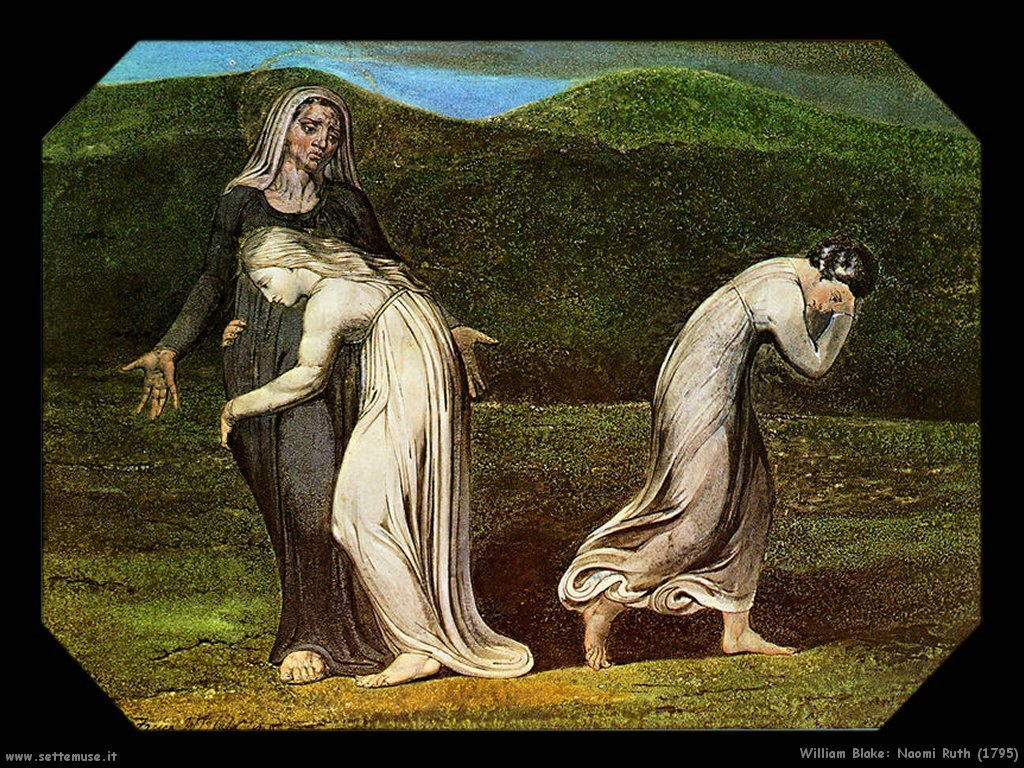
This subject has been popular in art for centuries. There's an Old Master at the Art and the Bible website, by Pieter Lastman ca. 1583–1633, entitled Ruth Declares her Loyalty to Naomi (1614). There's another in the Sudley House collection in Liverpool, by Ary Scheffer. William Blake got in on the act too:

Naomi entreating Ruth to follow Orpah (detail),
Illustration (1795) by William Blake (1757-1827)
Victoria and Albert Museum, London

There's a nice little picture of them on Monkey Mind, probably taken from an illustrated Bible:There's also a sort of quasi-Classicist depiction of them by Thomas Williams Rooke, entitled "Naomi, Ruth and Obed" (1876): There's a nice modern drawing, unattributed, with Hebrew text:This next one, from a blogpost entitled Ruth and Naomi: The Bible on Lesbians, is nice (and I like the pinky desert landscape). It looks as if they are just going to kiss...
Ruth and Naomi, Orpah departing, 1902
by Philip Hermogenes Calderon (1833-1898)