I had an interesting conversation the other day. I got chatting to a woman in a shop, and the conversation ranged over a number of topics, until it settled on same-sex marriage.
So this woman had loads of gay friends (so she said), and she was OK with civil partnerships, and yet she was opposed to same-sex marriage. Her reason was "but it says in the Bible..."
So I said, "But what about David and Jonathan? The Bible says that David's love for Jonathan surpassed his love for women". Oh yes, said the woman.
Then I said, "And what about Ruth and Naomi? The vow that Ruth made to Naomi is used in wedding ceremonies." And I talked about how amazing Ruth's love for Naomi was, that she was prepared to go to another country and risk being sold into slavery because she loved her so much. (Thanks to Kittredge Cherry for wising me up to the story of Ruth and Naomi.)
And then I said, "God is Love, right? And LGBT people love each other, so that must be godly."
And it seemed that I had succeeded in changing her mind.
Now, if I had called her a "bigot" at the outset of the conversation, that would have been it - end of conversation. And I don't think she was a bigot; she wanted to understand, and she seemed genuinely pleased to be offered a different interpretation of the Bible.
So, be careful before you jump to calling someone a bigot before you have found out what their real views are, under a possibly very thin veneer of religious conformity.
Also, it helps if you know how to do liberal Biblical interpretation.
Showing posts with label lesbian. Show all posts
Showing posts with label lesbian. Show all posts
Thursday, February 14, 2013

Tuesday, December 11, 2012
The complexity of marriage law - update
Legal (permitted by law and recognised by the state):
Being made legal soon:
Not forbidden by law, but not recognised by the state
- Opposite-sex church weddings (couple legally married and registered)
- Same-sex civil partnerships in a register office / registered premises for weddings
- Opposite-sex marriages in a register office / registered premises for weddings
- Religious civil partnerships (civil partnership ceremonies in a religious building)
- Same-sex weddings in register offices and those churches & synagogues that want to do them (couple legally married and registered)
- A transsexual person married to a person of the opposite sex to their original sex wanting to change their birth certificate to reflect their new sex will no longer have to divorce their partner (because when same sex marriage is legal, they can stay married).
- A transsexual person civilly partnered to a person of the same sex will be able to change / "upgrade" to a marriage (8.5 on page 27 of the consultation outcome document)
- Pagan same-sex handfastings in Scotland
The new arrangements for trans people are still not very satisfactory, as the conversion from one type of legal recognition to another will cost them money. This is particularly annoying for people who have already had to change their relationship status under the previous arrangements.
- same-sex blessings in a church / synagogue
- Pagan handfastings (weddings) in England & Wales
- Blessings of polyamorous relationships
- Humanist weddings - both same and opposite sex
- Opposite-sex civil partnerships in a register office / registered premises for weddings
- Marrying more than one person
Legal (permitted by law and recognised by the state) in Scotland only:
- Pagan opposite-sex handfastings where the celebrant says the required form of words (the same as for all other legal weddings)
Thursday, April 26, 2012
This video makes me uncomfortable
The Campaign for Equal Marriage video, Homecoming, made me uncomfortable.
As I am sure you are aware if you read my blogs or follow me on Twitter or Facebook, I support marriage equality. I want people to be able to marry each other if they want to, or have civil partnerships if they want to, regardless of gender. I want religions that want to perform marriages to be able to marry whoever they want.
So why did the video make me uncomfortable?
The main thing was the military setting. I'm a pacifist. I accept that wars happen sometimes, and that soldiers also carry out peacekeeping roles, but I think that we should do everything in our power to avoid war, and not to glorify it. The guy who is coming home is clearly returning from a military campaign (presumably in the Middle East as he is wearing desert camouflage). Given the controversy over Britain's recent wars in the Middle East, I find this difficult.
Then there's the statement at the end of the video "All men can be heroes: all men can be husbands". This has its good points, in that it undermines the myth that gay men are "effeminate" - but it also reinforces the view that gay men are OK if they're butch, but not if they're effeminate. And what about women who want to marry? What about bisexual and transgender people? What about disabled people who want a same-sex marriage? The statement is almost (but not quite) saying that being prepared to die for your country is what confers civil rights (so no marriage equality for conscientious objectors, then). No - being a citizen of a country is what confers civil rights.
Many GSD (gender and sexually diverse) people have criticised the marriage equality campaign for trying to make GSD people too much like the straights, and/or seeking to reassure the straights that we are just like them. I can understand this criticism; I do not want to be straight, I have never wanted to be straight, and I don't want to reassure the straight population that we are just like them. I think this video is a prime example of trying to reassure the straights that we are just like them. Would I be right in thinking that this video is aimed at people who read the Daily Mail?
What I did like about the video was the tender expressions on the faces of the two men, and the kneeling to propose marriage, and putting the wedding ring on the guy's finger. That was lovely. Put it in a non-military setting and I'll watch it lots.
But please, can we have a video with two guys, or two women, or both, in an ordinary setting?
As I am sure you are aware if you read my blogs or follow me on Twitter or Facebook, I support marriage equality. I want people to be able to marry each other if they want to, or have civil partnerships if they want to, regardless of gender. I want religions that want to perform marriages to be able to marry whoever they want.
So why did the video make me uncomfortable?
The main thing was the military setting. I'm a pacifist. I accept that wars happen sometimes, and that soldiers also carry out peacekeeping roles, but I think that we should do everything in our power to avoid war, and not to glorify it. The guy who is coming home is clearly returning from a military campaign (presumably in the Middle East as he is wearing desert camouflage). Given the controversy over Britain's recent wars in the Middle East, I find this difficult.
Then there's the statement at the end of the video "All men can be heroes: all men can be husbands". This has its good points, in that it undermines the myth that gay men are "effeminate" - but it also reinforces the view that gay men are OK if they're butch, but not if they're effeminate. And what about women who want to marry? What about bisexual and transgender people? What about disabled people who want a same-sex marriage? The statement is almost (but not quite) saying that being prepared to die for your country is what confers civil rights (so no marriage equality for conscientious objectors, then). No - being a citizen of a country is what confers civil rights.
Many GSD (gender and sexually diverse) people have criticised the marriage equality campaign for trying to make GSD people too much like the straights, and/or seeking to reassure the straights that we are just like them. I can understand this criticism; I do not want to be straight, I have never wanted to be straight, and I don't want to reassure the straight population that we are just like them. I think this video is a prime example of trying to reassure the straights that we are just like them. Would I be right in thinking that this video is aimed at people who read the Daily Mail?
What I did like about the video was the tender expressions on the faces of the two men, and the kneeling to propose marriage, and putting the wedding ring on the guy's finger. That was lovely. Put it in a non-military setting and I'll watch it lots.
But please, can we have a video with two guys, or two women, or both, in an ordinary setting?
Monday, April 23, 2012
Support marriage equality
Now is a good time to write to your local county councillors to ask them to support marriage equality.
Here is the letter I have written to my local councillors:
Here is the letter I have written to my local councillors:
I am writing to ask you to support marriage equality in Oxford County Council.The background to this is that Thanet County Council has endorsed the government's plans.
Thanet has become the first local authority in the UK to endorse the government’s proposals for marriage equality.
Some county councils have not yet made available information on how churches and synagogues that wish to do so can register for religious civil partnerships, and the registration fee is higher than for registering as a marriage venue. Please could you lobby for Oxfordshire County Council to do this.
In addition, I want to see marriage equality in the UK, and would hope that Oxfordshire's county councillors would support this. I want to see religious same-sex marriage made available for those religions and denominations that wish to perform these ceremonies (namely Unitarians, Liberal Judaism, Reform Judaism, Quakers, and the Metropolitan Community Church). Pagans would also like to be able to perform same-sex marriages, but as Pagan opposite-sex weddings have no legal standing in England and Wales, the nature of the obstacle to Pagan same-sex weddings is more complex.
Please also support the option for same-sex civil marriage and opposite-sex civil partnerships. This is important as many same-sex couples would like the opportunity to be married, and many opposite-sex couples would prefer the less traditional option.
This is also important for transgender people, who may be in either a civil partnership or a marriage currently, and in order to register as the opposite sex to the one they are currently labelled as, would have to divorce their partner and get either a civil partnership or a marriage.
Thanet has become the first local authority in the UK to endorse the government’s proposals for same-sex marriage. Please ask your councillors to pass a motion supporting same-sex civil marriages & opposite-sex civil partnerships. Find out your local councillors & email them via this website: www.writetothem.comPlease ask councillors to support same-sex marriage for those religions who want to do same-sex marriages too.
BBC report
Pink News report
Thursday, April 12, 2012
You can change
You know, some people become homophobic because of their upbringing. Perhaps they did not have the right parental role-modelling, so instead of turning into a normal balanced human being, they became homophobic.
Homophobia is a disease and requires our compassion and understanding. We should love the sinner and hate the sin. All you need to do is embrace diversity and you can be made whole.
Perhaps homophobes received insufficient nurture from their mothers, or guidance from their fathers, or did not have a positive LGBT role model in their lives.
God doesn't want you to be homophobic. She thinks homophobes are not part of Her divine plan for creation. In fact, God created everyone equal, and just wants you to have a fabulous time and be nice to people for a change. She created love in all its glorious forms so everyone could have a nice time - so quit kvetching and love thy neighbour!
Studies have shown that many homophobic people have experienced same-sex desire themselves, but are just not ready to admit it.
So there is a cure for homophobia.
Come out of the closet and be fabulous with the rest of us!
Homophobia is a disease and requires our compassion and understanding. We should love the sinner and hate the sin. All you need to do is embrace diversity and you can be made whole.
Perhaps homophobes received insufficient nurture from their mothers, or guidance from their fathers, or did not have a positive LGBT role model in their lives.
God doesn't want you to be homophobic. She thinks homophobes are not part of Her divine plan for creation. In fact, God created everyone equal, and just wants you to have a fabulous time and be nice to people for a change. She created love in all its glorious forms so everyone could have a nice time - so quit kvetching and love thy neighbour!
Studies have shown that many homophobic people have experienced same-sex desire themselves, but are just not ready to admit it.
So there is a cure for homophobia.
Come out of the closet and be fabulous with the rest of us!
Saturday, December 31, 2011
Same-sex love in the Bible
Ruth and Naomi, Jonathan and David, have often been held up as examples of same-gender love. They may or may not have been having some sort of sexual interaction - but it really doesn't matter. The important thing about their relationships is that they loved each other; and this can be inspiring, both for close same-gender friendships and same-gender sexual relationships.
It would be incorrect to assume that just because two people of the same sex love each other then that automatically means they must be lesbian or gay. It would be just as bad as automatically assuming that they can't have been lovers because they were in the Bible, and that everyone in the Bible was heterosexual.
The current identity of LGBTs is a relatively recent phenomenon. People classified sexualities differently in the past, e.g. the ancient Greeks classified people as either penetrators (strong, active) or penetrated (weak, passive) - so it was OK to be the penetrator but not the penetrated (women, eromenoi). So it makes no sense to back-project contemporary LGBT identities on to same-sex relationships of the past and/or other cultures. That's why many writers on this subject are careful to refer to "women-loving women" and "men-loving men" when talking about the past or other cultures - becuase then it doesn't assume that the same set of practices and cultural assumptions was happening. Conversely, there's nothing wrong with LGBT people viewing same-gender relationships from the past as inspirational, in fact it's a good thing.
To say that Ruth and Naomi might have been having a sexual relationship is not to "reduce" their relationship to "only" being about sex. Lesbian relationships are not solely about sex - they are also about love, caring, mutual support, friendship, shared values, shared interests, going for walks together, and so on.
It is important not to airbrush out sexuality from texts like the Bible, and ancient mythologies in general. Sexuality is sacred and part of human experience, and it can be deeply spiritual.
It is very important to LGBT Christians to see Ruth and Naomi, David and Jonathan as exemplars of samae-sex love. And I think it quite likely that there was at least an erotic aspect to their relationships. Rev Fred Hammond, a UU minister, points out:
It would be incorrect to assume that just because two people of the same sex love each other then that automatically means they must be lesbian or gay. It would be just as bad as automatically assuming that they can't have been lovers because they were in the Bible, and that everyone in the Bible was heterosexual.
The current identity of LGBTs is a relatively recent phenomenon. People classified sexualities differently in the past, e.g. the ancient Greeks classified people as either penetrators (strong, active) or penetrated (weak, passive) - so it was OK to be the penetrator but not the penetrated (women, eromenoi). So it makes no sense to back-project contemporary LGBT identities on to same-sex relationships of the past and/or other cultures. That's why many writers on this subject are careful to refer to "women-loving women" and "men-loving men" when talking about the past or other cultures - becuase then it doesn't assume that the same set of practices and cultural assumptions was happening. Conversely, there's nothing wrong with LGBT people viewing same-gender relationships from the past as inspirational, in fact it's a good thing.
To say that Ruth and Naomi might have been having a sexual relationship is not to "reduce" their relationship to "only" being about sex. Lesbian relationships are not solely about sex - they are also about love, caring, mutual support, friendship, shared values, shared interests, going for walks together, and so on.
It is important not to airbrush out sexuality from texts like the Bible, and ancient mythologies in general. Sexuality is sacred and part of human experience, and it can be deeply spiritual.
It is very important to LGBT Christians to see Ruth and Naomi, David and Jonathan as exemplars of samae-sex love. And I think it quite likely that there was at least an erotic aspect to their relationships. Rev Fred Hammond, a UU minister, points out:
The Hebrew word for love in the text is Ahava. Ahava is used some 250 times in the Hebrew Scriptures. It is used to refer to the sexual as in the very poetic Song of Songs. It is used to refer to the love of a husband for a wife. It is used to refer to passion in illicit relationships. It is used to refer to the love of Jonathan and David, and Ruth and Naomi, and it is used in the great commandment to love one’s neighbor as one self[2]. And while we translate ahava as love, it literally means “I will give.”The word Ahava is just as ambiguous (in the sense of whether it includes a sexual aspect) as our word, love. And this ambiguity leaves it open for a wide variety of ways to express love - and that can only be a good thing.
Monday, June 06, 2011
The complexity of marriage law
The subject of marriage and what is legal and what is not is getting increasingly more confusing, especially since a Liberal Jewish synagogue was in the news recently for performing a same-sex marriage (which is recognised by Liberal Judaism but not by the state). Apparently Scotland is just about to begin a process of consultation about same-sex marriage. So here's a list of what is and is not currently legal:
Legal (permitted by law and recognised by the state):
Legal (permitted by law and recognised by the state) in Scotland only:
Legal (permitted by law and recognised by the state):
- Opposite-sex church weddings (couple legally married and registered)
- Same-sex civil partnerships in a register office / registered premises for weddings
- Opposite-sex marriages in a register office / registered premises for weddings
- Religious civil partnerships (civil partnership ceremonies in a religious building)
- same-sex blessings in a church / synagogue
- same-sex marriages in a church / synagogue where the marriage is recognised by the church / synagogue but not by the state
- Pagan handfastings (weddings) in England & Wales - both same and opposite sex
- Pagan same-sex handfastings in Scotland
- Blessings of polyamorous relationships
- Same-sex church weddings (couple legally married and registered)
- Opposite-sex civil partnerships in a register office / registered premises for weddings
- Same-sex marriages in a register office / registered premises for weddings
- Marrying more than one person
Another difficulty is that if a transsexual married to a person of the opposite sex to their original sex wants to change their birth certificate to reflect their new sex, they would have to divorce their partner (whereas if same sex marriage were legal, they could stay married).
- Pagan opposite-sex handfastings where the celebrant says the required form of words (the same as for all other legal weddings)
Wednesday, May 18, 2011
Big Society or Bigoted Society?
In giving evidence to a Parliamentary Select Committee on the "Big Society", Derek McAuley, the Chief Officer of the General Assembly of Unitarian and Free Christian Churches, has pointed out that giving public service contracts to faith-based charities may result in discrimination against LGBT staff (particularly those who are transferred across under TUPE to the charities from local government) and clients.
Third Sector Online: Faith charities delivering public services 'could increase discrimination'
From the Unitarian Chief Officer: Faith charities delivering public services could increase discrimination
Third Sector Online: Faith charities delivering public services 'could increase discrimination'
From the Unitarian Chief Officer: Faith charities delivering public services could increase discrimination
Monday, September 27, 2010
Supporting Teen LGBTs
Many UU churches have LGBT teen support groups. There are some excellent resources on being a welcoming congregation for LGBT people on the UUA's Welcoming Congregations section.
I think at least one church in the UK has placed a LGBT rainbow flag outside their church. This is a widely-recognised sign of being LGBT-friendly. Also, at least one UK Unitarian church hires their premises to the Metropolitan Community Church. Another thing you can do is to arrange to talk to your local university's LGBT group about liberal religion - where I live, the local MCC minister has done this and I hope to do a talk this term. Reaching LGBT teens is harder because they are more isolated - but you could offer to do a talk at your local school.
Standing on the Side of Love has a section for congregational resources.
In the 1970s, Golders Green Unitarians held meetings of Integroup, a sharing group for LGBT people and allies. Dudley Cave, who was a member at GGU, was a founding member of the Lesbian and Gay Switchboard.
Stonewall also has excellent resources for schools.
Other resources
I think at least one church in the UK has placed a LGBT rainbow flag outside their church. This is a widely-recognised sign of being LGBT-friendly. Also, at least one UK Unitarian church hires their premises to the Metropolitan Community Church. Another thing you can do is to arrange to talk to your local university's LGBT group about liberal religion - where I live, the local MCC minister has done this and I hope to do a talk this term. Reaching LGBT teens is harder because they are more isolated - but you could offer to do a talk at your local school.
Standing on the Side of Love has a section for congregational resources.
In the 1970s, Golders Green Unitarians held meetings of Integroup, a sharing group for LGBT people and allies. Dudley Cave, who was a member at GGU, was a founding member of the Lesbian and Gay Switchboard.
Stonewall also has excellent resources for schools.
Other resources
- The Trevor Project - a nonprofit endeavour established to promote acceptance of lesbian, gay, bisexual, transgender and questioning (LGBTQ) youth, and to aid in suicide prevention among that group.
- Scarleteen - sex ed for the real world
- We are the youth - photographic journalism project chronicling the individual stories of queer youth in the United States
- "I'm From Driftwood" 50-State Story Tour: Collecting and Sharing True LGBT Stories.
Saturday, September 25, 2010
It Gets Better
Recently the media has been paying more media attention to teen LGBT suicides.
In response to this, Dan Savage has started a YouTube channel, "It Gets Better".
This deserves wide publicity, so please blog about it, tweet it, and post it on Facebook.
(via Geeky Sex and sexgenderbody)
In response to this, Dan Savage has started a YouTube channel, "It Gets Better".
Nine out of 10 gay teenagers experience bullying and harassment at school, and gay teens are four times likelier to attempt suicide. Many LGBT kids who do kill themselves live in rural areas, exurbs, and suburban areas, places with no gay organizations or services for queer kids. (...)
I wish I could have talked to this kid for five minutes. I wish I could have told Billy that it gets better. I wish I could have told him that, however bad things were, however isolated and alone he was, it gets better.
But gay adults aren't allowed to talk to these kids. Schools and churches don't bring us in to talk to teenagers who are being bullied. Many of these kids have homophobic parents who believe that they can prevent their gay children from growing up to be gay—or from ever coming out—by depriving them of information, resources, and positive role models.
Why are we waiting for permission to talk to these kids? We have the ability to talk directly to them right now. We don't have to wait for permission to let them know that it gets better. We can reach these kids.
So here's what you can do, GBVWS: Make a video. Tell them it gets better.
This deserves wide publicity, so please blog about it, tweet it, and post it on Facebook.
(via Geeky Sex and sexgenderbody)
Friday, March 12, 2010
You Shan't Go To The Prom!
I've just seen a shocking story about how a school in Mississippi won't allow a lesbian student to attend the prom with her girlfriend, and they wouldn't let her wear a tuxedo either.
Here's the email that I sent to tmcneece@itawamba.k12.ms.us, twiygul@itawamba.k12.ms.us
The ACLU has produced an online resource for LGBT students who want to take their partners to the Prom.
Here's the email that I sent to tmcneece@itawamba.k12.ms.us, twiygul@itawamba.k12.ms.us
Dear Superintendent McNeece and Principal Wiygul,I would encourage Stroppy Rabbit readers to write to the school on similar lines. You can get more information from the ACLU's letter on Constance's behalf (PDF).
I am writing to point out that lesbian and gay students have a right to bring a same-sex date to the prom and wear clothing congruent with their gender identity under the First Amendment, and the US Supreme Court has ruled that a policy or public entity that is based on discrimination against lesbian, gay, bisexual and transgender people violates the Fourteenth Amendment.
Simply cancelling the prom seems like a disproportionate response to a simple request to bring a same-sex partner. Please reinstate the prom and allow Constance McMillen to bring her partner as her date, and wear a tuxedo if she wishes.
I am deeply dismayed by your discriminatory practice, and feel that it should be a matter of regret to you that your school is now infamous around the world for this bigoted, disproportionate and unjust response to a lesbian student and her partner.
Yours sincerely
- ACLU: Mississippi High School Insists on "Straights-Only" Prom
- Facebook group in support of Constance McMillen
- Photos of lesbian couples at proms (Autostraddle)
- Pink News: US School cancels prom over lesbian student's date
The ACLU has produced an online resource for LGBT students who want to take their partners to the Prom.
Wednesday, March 03, 2010
A victory for common sense
This is fantastic news!
The House of Lords has voted by 95 to 21 votes to allow civil partnership ceremonies in religious premises. This means that denominations and religions who want to can marry same-sex couples.
Stonewall UK, Peter Tatchell, Unitarians, Quakers, Liberal Jews and the Metropolitan Community Church have campaigned for this change. The liberal think-tank Ekklesia has also welcomed the news.
However, what is needed now is a push towards full marriage equality for LGBT people, and also for other groups who are currently excluded, such as Pagans and the polyamorous.
Pagans also want to do same-sex legal weddings. However, Pagan opposite-sex weddings are only legal in Scotland, but they are not allowed to do same-sex legal weddings there. Hopefully this change in the law will also mean that LGBT Scottish Pagan couples can have legal weddings, even if neither opposite-sex nor same-sex English Pagan couples can.
The House of Lords has voted by 95 to 21 votes to allow civil partnership ceremonies in religious premises. This means that denominations and religions who want to can marry same-sex couples.
Stonewall UK, Peter Tatchell, Unitarians, Quakers, Liberal Jews and the Metropolitan Community Church have campaigned for this change. The liberal think-tank Ekklesia has also welcomed the news.
However, what is needed now is a push towards full marriage equality for LGBT people, and also for other groups who are currently excluded, such as Pagans and the polyamorous.
Pagans also want to do same-sex legal weddings. However, Pagan opposite-sex weddings are only legal in Scotland, but they are not allowed to do same-sex legal weddings there. Hopefully this change in the law will also mean that LGBT Scottish Pagan couples can have legal weddings, even if neither opposite-sex nor same-sex English Pagan couples can.
Friday, February 12, 2010
LGBT-friendly religions
I was hanging out in a gay bar last night and we ended up talking about religion (yeah, I know, it's no great surprise when I'm around, as it's one of my favourite topics of conversation) and discussing which are the most LGBT-friendly religions and denominations. Some of the people had never heard of some of the religions.
So, in no particular order, here are some of the more friendly ones:
Unitarianism
- The Divine has no gender.
- Unitarians have ordained LGBT ministers since 1977, and passed a number of motions at General Assembly in support of LGBT equality.
- Most Unitarian churches are willing to do same-sex blessings, and welcome LGBT members.
- Find out more about Unitarianism
Metropolitan Community Church
- A Christian church, founded by LGBT people for LGBT people
- Find out more about MCC
Buddhism
- All sex is liable to cause ego-attachments, so there's no particular prejudice against same-sex relationships
- Buddhist sexual ethics do not preclude particular practices but rather promote considerate behaviour
- Lots of androgynous statues
- Find out more about Buddhism
Eclectic Paganism
- Generally LGBT-friendly, but sometimes heterocentric.
- Find out more about eclectic Paganism
Wicca
- Sometimes heterocentric, but has the potential to be queered
- Isolated covens can sometimes be homophobic, but the mainstream is not
- Find out more about Wicca
Druidry
- Generally LGBT-friendly, but sometimes heterocentric.
- Find out more about Druidry
Polytheism
- Deities of many genders and sexualities
- Lots of LGBT adherents
- Sometimes the deities are too gendered
- Find out more about polytheism
Quakers
- peace-loving, tolerant
- recently approved same-sex weddings (they have been doing same-sex blessings for more than 20 years, apparently)
- Find out more about Quakers
- offer same-sex commitment ceremonies
- Find out more about Liberal Jews
See also
| Religion | Christianity • Islam • Judaism • Hinduism • Buddhism • Sikhism • Taoism • Shinto • Bahá'í • Confucianism • Scientology •Zoroastrianism • Unitarian Universalism • Voodoo • Wicca • Ásatrú |
|---|
Tuesday, January 19, 2010
Blogging on the Ride
I sponsored Jennifer Luu on the 2010 Soulforce Equality Ride, and have just heard that she's going to be blogging about the 2010 Ride at Advance Directive. Here's a sample:
If, as a member of an oppressed group, I take a stand against that oppression and decide that I will work against it, it doesn't make any sense to work only for my own personal interests. It doesn't make any sense for me to only fight for marriage equality when there are other queer people losing their jobs for being queer or killing themselves for being queer because THAT'S how much they hate themselves. (If you are unfamiliar with my usage of the word "queer," it goes like this: "queer" used to be a derogatory term aimed at LGBTQ people. It has since been liberatingly reclaimed by LGBTQ people to generally refer to that which is not heteronormative. The non-heteronormative part is why I like to use it-- it's shorter than LGBTQ and also rhymes with "cheer.") The people within my oppressed group that are more oppressed than I are more oppressed for reasons that inevitably have to do with issues of money/class and race. That is how I understand intersectionality. It's all connected. And it doesn't make any damn sense to forget about other oppressed peoples while I work my own way out of oppression because that doesn't do anything to end oppression-- it only ends MY oppression. It only moves oppression around-- shifts it from one group to another. Meanwhile, the dominant group stays dominant while the system they sit atop says, "suckeeeers!!!" And by forgetting and/or not recognizing the other oppressed, I become the oppressor. I'm not down with this. This is what "no one is free when others are oppressed" means to me. No one is better than anyone else.Good stuff.
Wednesday, December 09, 2009
2010 Equality Ride
Every day, thousands of lesbian, gay, bisexual, and transgender people suffer harassment, violence, and discrimination at the hands of those who do not understand them. This oppression usually hides in plain sight, masquerading as rigid doctrine or timeless tradition. Consequently, it often goes unchallenged and unchanged. Guided by principles of nonviolence, we at Soulforce Q approach these controversial issues with a readiness to meet people where they are. It is our belief that open and honest discussion begets understanding and healing, and that philosophy is at the heart of our work.
The Equality Ride is a traveling forum that gives young adults the chance to deconstruct injustice and the rhetoric that sustains it. It allows emerging young leaders to unite in the struggle for common equality. The idea is this. We get on a bus and journey to various institutions of higher learning. Through informal conversation and educational programming we explore concepts of diversity, comparing the effects of inclusive and exclusive viewpoints. More practically, we share and gain insights about how our beliefs influence policy and culture, thereby impacting society. Our goal is to carefully and collectively examine the intersection wherein faith meets gender and sexuality. Such discourse, especially when it affirms the beauty of our differences, plays an essential role in creating a safe learning and living environment for everyone.
Thus far, the Equality Ride has engaged nearly seventy academic communities. Many have shown considerable hospitality in welcoming us, and our legacy at those schools is one of mutual growth and compassionate fellowship. In addition to panels and schoolwide symposiums, we have joined students in cafeterias and coffee shops, participated in Bible studies and worship services, and given presentations in packed classrooms. Unfortunately, not every school chooses to host the Equality Ride. Voluntary redemptive suffering in the form of civil disobedience may become our avenue towards progress if, and only if, a school ignores the urgency and rejects dialogue.
A Movement in itself, the Equality Ride is empowering future generations to put their faith in action and make social justice a reality.
Donate to the Equality Ride
Tuesday, October 27, 2009
Eat up your ice-cream
Ben and Jerry's have renamed one of their flavours of ice-cream to HubbyHubby to celebrate the fact that same-sex couples can now marry in Vermont. Sweet!
Now you can eat ice-cream for equality. Fantastic!
Hat-tip to Isaac and Phaedra Bonewits, and best wishes to Isaac for a full recovery from his illness.
Monday, October 19, 2009
A manifesto
John Shelby Spong has issued a manifesto. I love it.
The battle is over. The victory has been won. There is no reasonable doubt as to what the final outcome of this struggle will be. Homosexual people will be accepted as equal, full human beings, who have a legitimate claim on every right that both church and society have to offer any of us. Homosexual marriages will become legal, recognized by the state and pronounced holy by the church. "Don't ask, don't tell" will be dismantled as the policy of our armed forces. We will and we must learn that equality of citizenship is not something that should ever be submitted to a referendum. Equality under and before the law is a solemn promise conveyed to all our citizens in the Constitution itself. Can any of us imagine having a public referendum on whether slavery should continue, whether segregation should be dismantled, whether voting privileges should be offered to women? The time has come for politicians to stop hiding behind unjust laws that they themselves helped to enact, and to abandon that convenient shield of demanding a vote on the rights of full citizenship because they do not understand the difference between a constitutional democracy, which this nation has, and a "mobocracy," which this nation rejected when it adopted its constitution. We do not put the civil rights of a minority to the vote of a plebiscite.Yes! Yes! Yes!
The battle in both our culture and our church to rid our souls of this dying prejudice is finished. A new consciousness has arisen. A decision has quite clearly been made. Inequality for gay and lesbian people is no longer a debatable issue in either church or state. Therefore, I will from this moment on refuse to dignify the continued public expression of ignorant prejudice by engaging it. I do not tolerate racism or sexism any longer. From this moment on, I will no longer tolerate our culture's various forms of homophobia. I do not care who it is who articulates these attitudes or who tries to make them sound holy with religious jargon.
Monday, September 28, 2009
Gay parents are just as good
Study finds no difference between children raised by gay or straight adoptive parents
(Pink News)
Kind of obvious, you would have thought, but apparently some people need telling this.
(Pink News)
Kind of obvious, you would have thought, but apparently some people need telling this.
A study of adoptive parents has found "no significant difference" in emotional problems experienced by children brought up by gay adoptive parents.
The US research, published in this month's Adoption Quarterly, surveyed 1,384 couples, 155 of whom were gay.
All were asked about their family structures, the child's history before being adopted, his or her current emotional state and family interactions.
Thursday, July 02, 2009
Naomi and Ruth in art
The Jesus in Love blog has a new painting of Naomi and Ruth, the very close friends (and possible lesbian partners) whose story is told in the Book of Ruth, part of the Ketuvim.

There's a nice little picture of them on Monkey Mind, probably taken from an illustrated Bible: There's also a sort of quasi-Classicist depiction of them by Thomas Williams Rooke, entitled "Naomi, Ruth and Obed" (1876):
  There's a nice modern drawing, unattributed, with Hebrew text:
 This next one, from a blogpost entitled Ruth and Naomi: The Bible on Lesbians, is nice (and I like the pinky desert landscape). It looks as if they are just going to kiss...

And Ruth said, Entreat me not to leave thee, or to return from following after thee: for whither thou goest, I will go; and where thou lodgest, I will lodge: thy people shall be my people, and thy God my God: Where thou diest, will I die, and there will I be buried.
Ruth 1:16-17
This subject has been popular in art for centuries. There's an Old Master at the Art and the Bible website, by Pieter Lastman ca. 1583–1633, entitled Ruth Declares her Loyalty to Naomi (1614). There's another in the Sudley House collection in Liverpool, by Ary Scheffer. William Blake got in on the act too:
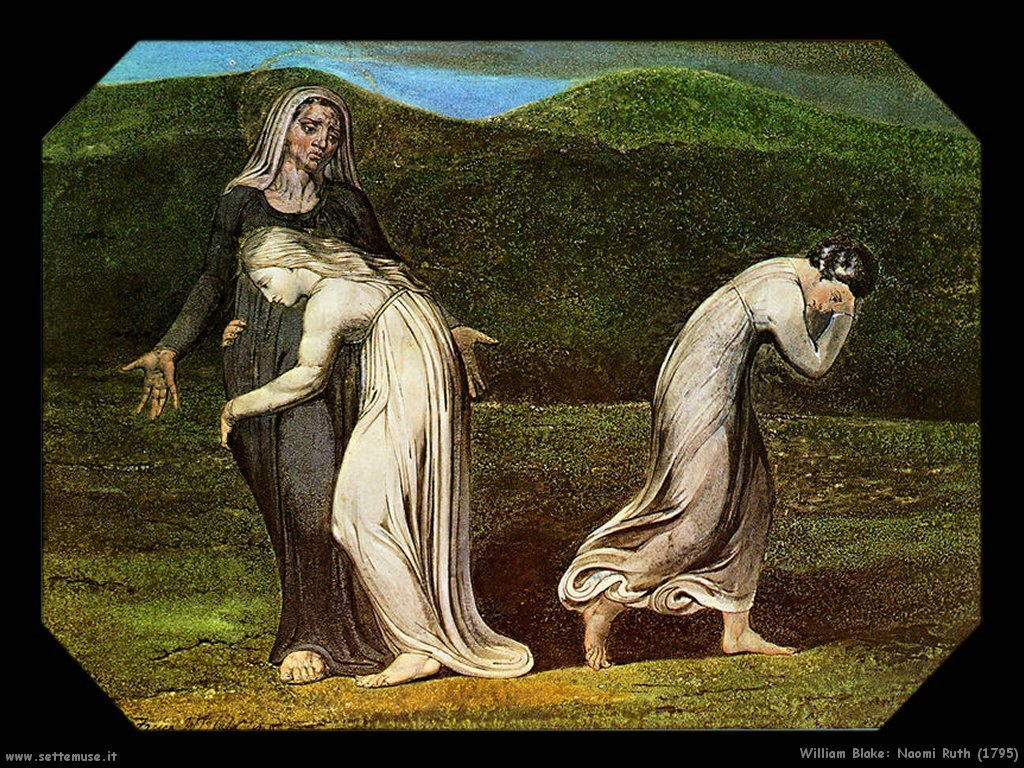
Naomi entreating Ruth to follow Orpah (detail),
Illustration (1795) by William Blake (1757-1827)
Victoria and Albert Museum, London
 There's also a sort of quasi-Classicist depiction of them by Thomas Williams Rooke, entitled "Naomi, Ruth and Obed" (1876):
  There's a nice modern drawing, unattributed, with Hebrew text:
 This next one, from a blogpost entitled Ruth and Naomi: The Bible on Lesbians, is nice (and I like the pinky desert landscape). It looks as if they are just going to kiss...
Ruth and Naomi, Orpah departing, 1902
by Philip Hermogenes Calderon (1833-1898)
Friday, March 06, 2009
LGBT in HE
A new report by the Equality Challenge Unit says that the higher education sector needs to address sexual orientation and trans-status discrimination.
Based on a survey of 4205 staff and students in England, Wales and Northern Ireland the research, led by Professor Gill Valentine at the University of Leeds, found that institutions provide a positive space for LGBT students.So it seems that higher education is a relatively safe place to be, but not completely safe.
However, there are still high levels of homophobia and discrimination on campus, a factor that contributes to 20% of LGB and 28.5% of trans students suspending their studies. 33.8% of LGB staff and 41% of trans staff who took part in the research have experienced discrimination and abuse from colleagues.
Subscribe to:
Posts (Atom)