Showing posts with label art. Show all posts

Tuesday, October 08, 2013

Women's history 101

People often ask, why are there so few famous women writers, artists, scientists, and intellectuals?

They seem to be forgetting that, in previous centuries, it was rare for women to be educated. Women also often died younger due to infections contracted in childbirth.

Women were not allowed to attend university until the 1870s, and even then they were not allowed to graduate.
At the beginning of the 20th century it was very difficult for women to obtain a university education. In 1870 Emily Davies and Barbara Bodichon helped to set up Girton College, the first university college for women, but it was not recognised by the university authorities. In 1880 Newnham College was established at Cambridge University. By 1910 there were just over a thousand women students at Oxford and Cambridge. However, they had to obtain permission to attend lectures and were not allowed to take degrees. 
Without a university degree it was very difficult for women to enter the professions. After a long struggle the medical profession had allowed women to become doctors. Even so, by 1900 there were only 200 women doctors. It was not until 1910 that women were allowed to become accountants and bankers. However, there were still no women diplomats, barristers or judges. (John Simkin)
The first social groups to routinely educate their daughters were the Unitarians and the Religious Society of Friends (Quakers), starting in the 1840s.

When women did succeed in producing literature or scientific research, quite often someone else got the credit for it, or their contribution or achievement was minimised. Even now, there are people who dispute that Ada Lovelace wrote programs for Babbage's calculating engine, and want to impute authorship of the Brontë sisters novels' to their brother Branwell. The scientific achievements of Lise Meitner, Cecilia Payne-Gaposchkin, Hedy Lamarr, Dorothy Hodgkin, Rosalind Franklin, Katherine Jones, Jocelyn Bell-Burnell, Caroline Herschel, and many others, are forgotten or sidelined. I did not learn about any of these women at school - I found out about them by researching on the internet, and reading blogposts from the Finding Ada project.

Many nineteenth-century female scientists and mathematicians were told that their scientific and mathematical activities were bad for their womb. Many were prevented from attending university, or not allowed to graduate, or made to work in a separate laboratory from the men.

The work of female writers, poets, artists, composers, and playwrights suffered a similar fate. Artemisia Gentileschi's paintings were attributed to her father. The Nobel Prize for Jocelyn Bell Burnell's discovery of pulsars went to her male PhD supervisor. The work of the women Pre-Raphaelite and Impressionist artists is largely forgotten.

A similar fate happens to Black & minority ethnic (BME) and LGBT scientists, authors, and heroes. And if you are a woman and BME and LGBT, then you are doubly or triply doomed to be sidelined. Just look at the marginalisation of Mary Seacole, Edward Carpenter, Goldsworthy Lowes Dickinson, and many another BME and/or LGBT person.

Even today, women's novels are marketed as less serious than novels by men. They also receive less reviews in serious journals.  The novels of white male authors are taught on English literature courses; the novels of female authors are taught on courses of women's studies or women's literature. Maureen Johnson writes:
For much of history, women read the works of men. Every once in a while we see a woman cracking through, maybe changing her name, maybe hiding her work, or maybe breaking through the strength of her genius or good luck or both. Then we see a huge break in the early 20th century, a flux of brilliant women. Women start to climb into the bestseller charts, but not so much into the reading lists.
There is no doubt that women (despite massive disadvantages) have achieved great things in every field of artistic, literary, and scientific endeavour, but all too often, they are forgotten, sidelined, their achievements dismissed or diminished, their work not taught in schools or universities. The corpus of literature that is considered "the canon" is overwhelmingly by white men (usually dead white men, usually heterosexual). No-one is saying that these authors should no longer be taught; just that "the canon" should include women, BME people, and LGBT people.

Thursday, July 02, 2009

Naomi and Ruth in art

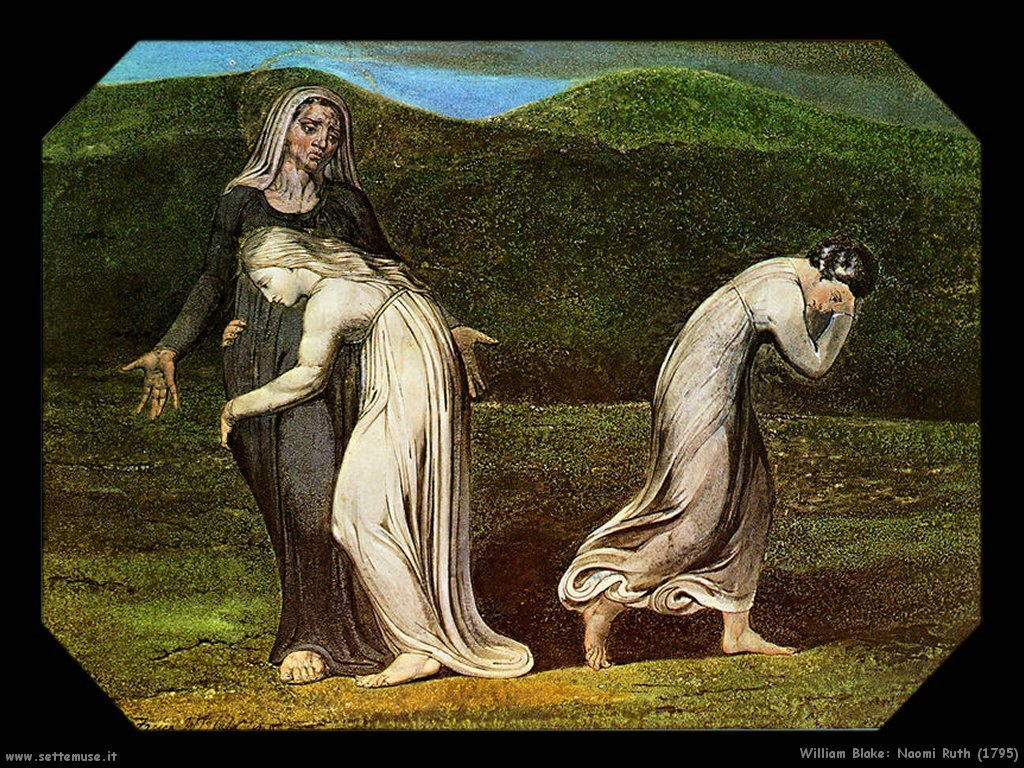
The Jesus in Love blog has a new painting of Naomi and Ruth, the very close friends (and possible lesbian partners) whose story is told in the Book of Ruth, part of the Ketuvim.
And Ruth said, Entreat me not to leave thee, or to return from following after thee: for whither thou goest, I will go; and where thou lodgest, I will lodge: thy people shall be my people, and thy God my God: Where thou diest, will I die, and there will I be buried.

Ruth 1:16-17
This subject has been popular in art for centuries. There's an Old Master at the Art and the Bible website, by Pieter Lastman ca. 1583–1633, entitled Ruth Declares her Loyalty to Naomi (1614). There's another in the Sudley House collection in Liverpool, by Ary Scheffer. William Blake got in on the act too:

Naomi entreating Ruth to follow Orpah (detail),
Illustration (1795) by William Blake (1757-1827)
Victoria and Albert Museum, London

There's a nice little picture of them on Monkey Mind, probably taken from an illustrated Bible:There's also a sort of quasi-Classicist depiction of them by Thomas Williams Rooke, entitled "Naomi, Ruth and Obed" (1876): There's a nice modern drawing, unattributed, with Hebrew text:This next one, from a blogpost entitled Ruth and Naomi: The Bible on Lesbians, is nice (and I like the pinky desert landscape). It looks as if they are just going to kiss...
Ruth and Naomi, Orpah departing, 1902
by Philip Hermogenes Calderon (1833-1898)

Monday, June 23, 2008

the original stroppy rabbit

A painting seen in a shop window in York:

(if it's not the actual picture after which I named this blog, then it's by the same artist)

Wednesday, August 15, 2007

Coptic art

Did anyone else see the fabulous Art of Eternity programme with Andrew Graham-Dixon? There was some beautiful Coptic art - very geometric and happy-looking saints. You could see the connection with the art of Celtic Christianity as well (the Coptic Church was allegedly the first to evangelise Britain). Wonderful stuff.

Thursday, June 07, 2007

gay surreal abstract art

Technophilia by Frank Pietronigro
Frank Pietronigro's paintings are like a surrealist 3D version of Miro's paintings, with a dash of Kandinsky - well, that's the nearest I can get to describing it.

He also does installations, including one he did in free-fall on a NASA flight, and Documents: Deconstructing Homophobic Signifiers, where he stencils homophobic slang on the floor in salt and then people walk on it, literally destroying the homophobic words. What a great idea - kind of a magical act, really.

Another of his projects that was even more of a ritual was Angels of Alcatraz, where a bunch of people dressed as angels visited Alcatraz and filled it with positive energy, embodying a specific positive word and projecting their healing energies into anywhere that felt particularly negative. The aim was to send the energy across time to the prisoners. How beautiful.

Monday, May 21, 2007

the art of Elisabeth Ohlson Wallin

Featured in Kittredge Cherry's latest book, Art that Dares, Elisabeth Ohlson Wallin's work is a series of dramatic (sometimes disturbing, as in the series In Hate We Trust) photos. Her series Ecce Homo (key scenes from the life of Christ with a queer twist) is amazing. It received a very varied reception; some Christians saw it as a sacred expression of Jesus' relationship with outcasts; others saw it as a "satanic trick" and one man attacked two of the pictures with an axe - what a sicko. Ohlson Wallin based the tableaux on classic paintings. The full story appears in Art that Dares (Cherry, 2007). Check out Ohlson Wallin's website; better still, buy the book.

Friday, May 18, 2007

James Bidgood

Precious few people seem to have heard of the fabulous Pierre et Gilles, so presumably even less have heard of the lovely James Bidgood (who influenced their work).

I was lucky enough to get a signed copy of Corps Divins (P & G's more recent work) off the Marketplace of Amazon.fr - and the photos are beautiful. Particularly the Mercury one.

Anyway, I googled for James Bidgood and found more information than I had previously. He made a film called Pink Narcissus in the 60s and you can now get it on DVD.

Here are some of Bidgood's photos:Pan by James Bidgood
Pan by James Bidgood

From the film Pink NarcissusFrom the film Pink Narcissus

Thursday, May 17, 2007

Pierre et Gilles

The French photographers Pierre et Gilles have produced numerous images of Christian saints, Hindu deities, and classical deities (Marcadé and Cameron, 1997: 197-223), and many of them are gay icons in one way or another (Vallet, 2006). The series of photographs of saints begins in 1987 with an image of Saint Sebastian, looking remarkably calm as he is transfixed with arrows, lashed to a tree-stump with garlands of roses. Sebastian has been a symbol of same-sex love at least since the Renaissance (Conner et al, 1997: 297), hence Derek Jarman’s remarkable film of the same name, and Pierre et Gilles created two more images of him in 1994 (Sébastien de la Mer) and 1996 (Le martyre de Saint Sébastien). Sebastian was also painted by numerous Renaissance painters, including Giovanni Antonio Bazzi, nicknamed ’Il Sodoma’ (Conner et al, 1997: 85). Pierre et Gilles have produced numerous other saints and deities, all depicted in an ornate and beautiful style. These include Joan of Arc, presumably chosen by the artists for her gender-bending activities and possible lesbianism (Conner et al, 1997: 190), whom they depicted in 1988 and 1997, dressed in armour and gazing into the distance. They also produced an image of Sainte Affligée, known in English as Uncumber or Wilgefortis, a legendary figure who grew a beard to avoid marriage (Becker-Huberti, undated). There are numerous other saint pictures, some of which seem to have homoerotic connotations, but mostly seem somewhat randomly selected.

Pagan deities that they have depicted include Adonis (1992), Amphytrite (1989), Bacchus (1991), Medusa (1990), Orpheus (1990), Venus (1991, 1992 and 2000), Adonis (1992 and 1999), Eros (2003), Mercury (2001), Ganymede (2001), and Diana (1997). Medusa is sometimes seen as a lesbian icon (Conner et al, 1997: 229). Orpheus chose male lovers after failing to retrieve Eurydice from the underworld, and it was for this that the Maenads tore him apart; legend has it that his friend Sappho buried his head (Conner et al, 1997: 258). Adonis was the eromenos of Dionysos (Conner et al, 1997: 43). Eros was also a symbol of same-sex love in ancient Greece (Conner et al, 1997: 132), among the Lacedaemonians and the Athenians for example. In alchemical texts, Mercury was frequently depicted as an androgyne; in Pierre et Gilles’ 2001 work, he appears as a graceful and muscular youth. Ganymede is well-known as the eromenos of Zeus, and the term Ganymede (or its Latin equivalent, ‘catamite’) was used as a term for young men who took the receptive role in homoerotic relationships in the medieval period by both pro- and anti-homosexual writers (Conner et al, 1997: 155). According to mythology, Diana shunned the company of men and preferred the company of women. It would seem from this brief survey that the association of the deity or saint with same-sex love or gender-bending may be a factor in their selection by Pierre et Gilles as a subject.