My own view is that the Easter story is one of many stories of dying and resurrecting deities. In these stories, the hero dies, descends to the underworld, and returns to the mortal world bringing some blessing or new knowledge. Persephone is taken to the Underworld by force, but returns every six months; Gilgamesh goes to rescue his friend Enkidu from death; Orpheus goes to rescue Eurydice. Jesus goes there to rescue the souls of those trapped in Gehenna (this is referenced in the only letter of the Apostle Peter). In Christus Victor theology, which is prevalent among the Eastern Orthodox churches, Jesus “tramples down death by death” and because he is God, cannot be contained by death, and so transcends it. He then returns transformed into a being who can manifest as he chooses — by the Sea of Galilee, or on the road to Emmaus. The mythical journey undergone by all these heroes and heroines is a descent into death and the underworld, returning transformed into something greater, and bringing back a gift for humanity. The hymn Now the green blade rises references this mythological and transformational aspect of the Easter story.
The spiritual journey involves the same transformation — the death of the ego, the descent into the dark night of the soul, and the resurrection as the True Self. In Orthodox Christian theology, this transformation is called theosis, literally deification, making us divine. It’s not too hard to see an analogy with the Buddhist concept of enlightenment. As James Martineau, the 19th century Unitarian theologian, said, “The Incarnation is true, not of Christ exclusively, but of Man universally, and God everlastingly. Humanity is the susceptible organ of the Divine, and he bends into it to dwell there.”
In Orthodox churches, Easter is celebrated as a unified event, and is regarded as being in the present, the eternal Now. So on Easter Sunday, people greet each other with “Christos Anesti” (Christ is risen) - because he is risen in their hearts and in the church which is his mystical body (and they presumably believe it literally as well).
In the Eleusinian Mysteries, people witnessed the unfolding drama of the story of Persephone’s descent into the Underworld, and underwent a profound transformation or initiation as a result.
You can enjoy Easter on a mythical and mystical level. There’s no need to take it literally to enjoy the unfolding drama of the Mystery. We can witness the many stories of death and resurrection and experience transformation ourselves, like participants in a mystery tradition.
Wednesday, March 26, 2014

Tuesday, March 18, 2014
What happens when the oil runs out?
 I am currently reading the Emberverse series by S M Stirling, in which electronics, guns, the internal combustion engine, and gunpowder all stop working overnight. The laws of physics have been tampered with by some unknown power. The books explore the consequences of this strange event, known as the Change. Part of the story follows a small group of Georgian Wiccans who take to the hills; another part deals with a man who decides to set up a feudal Norman-style state. The people who do best are those with some skills in farming, making things, but also, the ones who are rich in stories that help make sense of the world, which help them to build just and cohesive societies.
I think that the Change is shorthand, or a metaphor, for what happens when the oil runs out. It won't happen overnight, and if we are lucky, it will be managed sensibly. But all the current indications are that it will not be managed sensibly. Instead of reducing our dependency on fossil fuels, companies are inventing ever more destructive ways of wresting them from the ground, the worst of these being fracking. We are also not investing in sustainable power sources, or taxing carbon consumption, or anywhere near enough of the things we should be doing. The warning signs of climate change are being ignored.
Rhyd Wildermuth's story, What we built from ruins (part 1 and part 2), in response to the question, what will Paganism look like in fifty years' time? got me thinking, as well. I realised that my response completely ignored the question of what will happen when the oil runs out.
I also recently attended a ritual in my local area that was part of a global magical working to protect the waters of the world from fracking, which is about the most irresponsible and damaging thing anyone could possibly do to the environment. It was a very moving and beautiful ritual, and it brought together eco-activists, Pagans, shamans, and others.
So what can Pagans and other ecologically-minded people be doing to prepare for the eventual crash, or shift?
We can reduce our own dependence on fossil fuels; campaign for investment in sustainable energy sources; campaign for environmental and social justice. But in addition to these, we can do magic (the art of changing consciousness in accordance with Will) to heal and protect the Earth and other living beings, and we can learn skills such as building roundhouses and coracles and boats, raising livestock, weaving, growing our own food, and so on. We can get involved with the transition towns movement and other sustainability initiatives, support organic farming, and check our own ecological footprint. We can build strong communities - not only of Pagans, but including others of good will. And we can engage with stories that show how to build just, cohesive, and inclusive societies. We are already doing all this to a certain extent - we just need to do it more.
Friday, January 03, 2014
The old lie, dulce et decorum est...
I have no words apart from "A la lanterne!" for this. Apparently Michael Gove has had a go at historians and TV for the "Blackadder myths" about the First World War, saying it was not really that bad. (I won't share the link because it is from the Daily Mail.) No, Gove, the First World War really was that bad. The mud that sucked men down to their deaths, the trench-foot, the lice that made men's clothes move on their own, the endless pounding of the shells, the gas ("if in dreams you too could pace behind the wagon that we flung him in, and watch him guttering, choking drowning"), the death and maiming of comrades, the utter waste of life, the incomprehensible slaughter of thousands in a single day for a tiny piece of land. The horrific carnage of Gallipoli. So do NOT repeat to us the old lie, "Dulce et decorum est, pro patria mori". It is neither sweet nor meet, it is death, too early, and in horrific ways that an idiot like Gove probably can't even imagine.
Monday, December 02, 2013
Camp
"You keep using that word. I do not think it means what you think it means."It has come to my attention that straight people frequently misuse the word "camp" to mean "excessively effeminate", more or less.
~ Inigo Montoya
Now, in case you don't know this, heterosexuals, that word does not mean what you think it means.
The word camp comes from Polari, the argot used by gay people from the late 19th to the mid-20th century. When I first encountered the word (some time in the early 1980s), it meant something like arch, wry, cheeky, or slightly over-decorated (hence the expression "as camp as Christmas"). It is possibly derived from Italian campare "to exaggerate, make stand out".
It did not mean "excessively effeminate" - that was covered by the expression "screaming queen" (but please do not attempt to use that phrase either, straight people).
Kenneth Williams was camp because of the style of humour that he used, not because of any other factor about him.
Tuesday, October 08, 2013
Women's history 101
People often ask, why are there so few famous women writers, artists, scientists, and intellectuals?
They seem to be forgetting that, in previous centuries, it was rare for women to be educated. Women also often died younger due to infections contracted in childbirth.
Women were not allowed to attend university until the 1870s, and even then they were not allowed to graduate.
When women did succeed in producing literature or scientific research, quite often someone else got the credit for it, or their contribution or achievement was minimised. Even now, there are people who dispute that Ada Lovelace wrote programs for Babbage's calculating engine, and want to impute authorship of the Brontë sisters novels' to their brother Branwell. The scientific achievements of Lise Meitner, Cecilia Payne-Gaposchkin, Hedy Lamarr, Dorothy Hodgkin, Rosalind Franklin, Katherine Jones, Jocelyn Bell-Burnell, Caroline Herschel, and many others, are forgotten or sidelined. I did not learn about any of these women at school - I found out about them by researching on the internet, and reading blogposts from the Finding Ada project.
Many nineteenth-century female scientists and mathematicians were told that their scientific and mathematical activities were bad for their womb. Many were prevented from attending university, or not allowed to graduate, or made to work in a separate laboratory from the men.
The work of female writers, poets, artists, composers, and playwrights suffered a similar fate. Artemisia Gentileschi's paintings were attributed to her father. The Nobel Prize for Jocelyn Bell Burnell's discovery of pulsars went to her male PhD supervisor. The work of the women Pre-Raphaelite and Impressionist artists is largely forgotten.
A similar fate happens to Black & minority ethnic (BME) and LGBT scientists, authors, and heroes. And if you are a woman and BME and LGBT, then you are doubly or triply doomed to be sidelined. Just look at the marginalisation of Mary Seacole, Edward Carpenter, Goldsworthy Lowes Dickinson, and many another BME and/or LGBT person.
Even today, women's novels are marketed as less serious than novels by men. They also receive less reviews in serious journals. The novels of white male authors are taught on English literature courses; the novels of female authors are taught on courses of women's studies or women's literature. Maureen Johnson writes:
They seem to be forgetting that, in previous centuries, it was rare for women to be educated. Women also often died younger due to infections contracted in childbirth.
Women were not allowed to attend university until the 1870s, and even then they were not allowed to graduate.
At the beginning of the 20th century it was very difficult for women to obtain a university education. In 1870 Emily Davies and Barbara Bodichon helped to set up Girton College, the first university college for women, but it was not recognised by the university authorities. In 1880 Newnham College was established at Cambridge University. By 1910 there were just over a thousand women students at Oxford and Cambridge. However, they had to obtain permission to attend lectures and were not allowed to take degrees.
Without a university degree it was very difficult for women to enter the professions. After a long struggle the medical profession had allowed women to become doctors. Even so, by 1900 there were only 200 women doctors. It was not until 1910 that women were allowed to become accountants and bankers. However, there were still no women diplomats, barristers or judges. (John Simkin)The first social groups to routinely educate their daughters were the Unitarians and the Religious Society of Friends (Quakers), starting in the 1840s.
When women did succeed in producing literature or scientific research, quite often someone else got the credit for it, or their contribution or achievement was minimised. Even now, there are people who dispute that Ada Lovelace wrote programs for Babbage's calculating engine, and want to impute authorship of the Brontë sisters novels' to their brother Branwell. The scientific achievements of Lise Meitner, Cecilia Payne-Gaposchkin, Hedy Lamarr, Dorothy Hodgkin, Rosalind Franklin, Katherine Jones, Jocelyn Bell-Burnell, Caroline Herschel, and many others, are forgotten or sidelined. I did not learn about any of these women at school - I found out about them by researching on the internet, and reading blogposts from the Finding Ada project.
Many nineteenth-century female scientists and mathematicians were told that their scientific and mathematical activities were bad for their womb. Many were prevented from attending university, or not allowed to graduate, or made to work in a separate laboratory from the men.
The work of female writers, poets, artists, composers, and playwrights suffered a similar fate. Artemisia Gentileschi's paintings were attributed to her father. The Nobel Prize for Jocelyn Bell Burnell's discovery of pulsars went to her male PhD supervisor. The work of the women Pre-Raphaelite and Impressionist artists is largely forgotten.
A similar fate happens to Black & minority ethnic (BME) and LGBT scientists, authors, and heroes. And if you are a woman and BME and LGBT, then you are doubly or triply doomed to be sidelined. Just look at the marginalisation of Mary Seacole, Edward Carpenter, Goldsworthy Lowes Dickinson, and many another BME and/or LGBT person.
Even today, women's novels are marketed as less serious than novels by men. They also receive less reviews in serious journals. The novels of white male authors are taught on English literature courses; the novels of female authors are taught on courses of women's studies or women's literature. Maureen Johnson writes:
For much of history, women read the works of men. Every once in a while we see a woman cracking through, maybe changing her name, maybe hiding her work, or maybe breaking through the strength of her genius or good luck or both. Then we see a huge break in the early 20th century, a flux of brilliant women. Women start to climb into the bestseller charts, but not so much into the reading lists.There is no doubt that women (despite massive disadvantages) have achieved great things in every field of artistic, literary, and scientific endeavour, but all too often, they are forgotten, sidelined, their achievements dismissed or diminished, their work not taught in schools or universities. The corpus of literature that is considered "the canon" is overwhelmingly by white men (usually dead white men, usually heterosexual). No-one is saying that these authors should no longer be taught; just that "the canon" should include women, BME people, and LGBT people.
Monday, September 23, 2013
William Adam and Rammohun Roy
William Adam was born in 1796 in Dunfermline, Fife, Scotland, and began his ministry as a Baptist missionary in India. Whilst in India, he met Rammohun Roy, who converted him to Unitarianism.
The story of William Adam represents in microcosm the conflict between the universalising view of religion and the particular and cultural view of religion.
The view that there are universal and perennial themes in religion is usually viewed as a good and liberal view – it can allow for interfaith dialogue, and promote tolerance.
However, there is a darker side to this universalising tendency – the idea that one faith is universally the right faith for everyone. Christianity, Islam, and Buddhism have all claimed that they are religions for the whole of humanity.
Particularism is often derided as a narrow and sectarian view that one’s own tradition is the one true way; but in fact, particularism at its best can involve engaging deeply and faithfully with one’s own tradition, whilst recognizing that others’ particular traditions are right for them. Judaism, Hinduism, Taoism, and Paganism (as well as many liberal Christians) all recognize that they are embedded in a particular culture and mythology, and derive meaning and depth from their particularity.
William Adam sincerely believed that Christianity was the one true faith, and that the lives of the people of India would be improved if they adopted it. Rammohun Roy succeeded in converting him to the doctrine of the Unity of God, rather than the Trinity, and thereafter, Adam was an enthusiastic advocate of the Unitarian Christianity of his day.
Rammohun Roy, on the other hand, never relinquished his Hindu faith, despite being a Hindu Unitarian. When he came to England, he brought his Brahmin cook, and continued to wear the red cord of his Brahmin status, and was eventually buried in a Vedic tomb constructed by Hindu stonemasons. Roy wished to reform Hinduism by purging it of superstitious practices – especially widow-burning.
Both Adam and Roy wrote to American Unitarians to enlist support for missionary efforts in Bengal; however, Roy never expressed support for conversion of the people to Christianity; he emphasized the importance of education. Adam, on the other hand, wanted to convert Hindus and Muslims to Christianity, and thought that Unitarian doctrines were more rational than Trinitarian ones, and therefore had more chance of succeeding.
So Roy, in continuing to be a Hindu, effectively supported the particular tradition of Hinduism, which was embedded in Indian culture and philosophy. In a letter to Henry Ware, an American Unitarian, Roy wrote:


Adam, on the other hand, wanted to convert people of other religions to Christianity, taking the view that it was universally true for everyone, regardless of their cultural context.
He did not get much support for his efforts at evangelism from Unitarians in Britain and America, however, either because they were disorganized and preoccupied with their own affairs, or perhaps because they shared Rammohun Roy’s view that every nation had its own form of worship, and all those forms were acceptable to God.
Eventually Adam gave up trying to spread Christianity in India, and turned his efforts to the abolition of slavery instead. Here I find myself much more in sympathy with his efforts, especially as he insisted that women should be allowed to fully participate in the meetings of the World Anti-Slavery Convention in June,1840, in London. He had first got involved in the anti-slavery cause in 1838, and subsequently joined the abolitionist cause in America, too.
He became a Unitarian minister in America and then Canada, where he was Toronto’s first Unitarian minister, but financial difficulties made his position there untenable as he fell out with the congregation. He then moved to Chicago and became a minister there.
He returned to England without his family around 1855, and by 1861, had renounced Unitarianism and ceased his involvement with it. Instead he was writing a book criticizing Auguste Comte, who had attempted to create his own universal religion, a sort of precursor of Alain de Botton’s religion for atheists.
William Adam died in 1881, and left his money to Dumfermline Grammar School for University scholarships, stipulating that the funds should be distributed "irrespective of sex or creed or no creed, parentage, colour or caste, nationality or political allegiance".
He was clearly a complex man, fairly typical of the Victorian period, believing in the superiority of Christianity, but also embracing equality for women, the abolition of slavery, and the importance of education. He is also noteworthy for having been converted to Unitarianism by Rammohun Roy, a Hindu, who persuaded him that the Unitarian interpretation of the gospels was the correct one.
Andrew Hill writes:
Roy convinced Adam that the meaning of the Greek preposition dia required that John 1:3, a verse of the prologue to John's Gospel, be translated as the Bengali equivalent of the English words, 'All things were made through the Word. . .' not 'by the Word'. Translators of New Testament Greek in later generations would come to agree, but in 1821 the view of nature of Christ, supported by this translation and espoused by Adam and Rammohun, was rejected by orthodox Christians as the Arian heresy (named for the 4th century CE dissident, Arius). For this reason colleagues nicknamed him 'the second fallen Adam'.Unitarians have been chortling at this joke ever since; but poor William Adam brought his evangelical zeal across intact from his Baptist faith, and was met with lukewarm enthusiasm by his new Unitarian colleagues.
Ultimately he was disappointed in Unitarianism and turned his considerable energies towards other causes, mainly education and the abolition of slavery. By all accounts he was a bit of a difficult man to get along with; but he was clearly intelligent and enthusiastic, having learnt Sanskrit and Bengali in preparation for his time in India, and having committed himself to his chosen causes with dedication and zeal; even being prepared to stick his neck out on behalf of the women excluded from the anti-slavery convention of 1840.
It is also likely that without his efforts, the fledgling Brahmo Samaj would not have gained such widespread support as it did.
William Adam was an interesting character and an illustration of the many conflicting currents of Victorian activism, moving as he did from evangelical circles to abolitionism; a minor character in the drama of Rammohun Roy, but worthy of study nevertheless.
Yvonne Aburrow
Sources:
Abidullah Al-Ansari Ghazi (2010), Raja Rammohun Roy: Encounter with Islam and Christianity and the Articulation of Hindu Self-Consciousness. Google eBook.
Andrew M Hill, William Adam. (in Dictionary of Unitarian & Universalist Biography) http://www25.uua.org/uuhs/duub/articles/williamadam.html
Wednesday, February 20, 2013
Fat is a social issue
There was an excellent article in The Guardian yesterday on obesity by Rae Earl.
» Obesity epidemic: as a lifelong comfort eater, I understand the emotional pull of food
» Obesity epidemic: as a lifelong comfort eater, I understand the emotional pull of food
Some of the comments on it were idiotic. People said things like losing weight is just a matter of willpower, and all you have to do is to eat less and exercise more. If that were the case, there wouldn't be an obesity epidemic.
My weight loss
At the beginning of 2009, I was 18 stone, and lost four stone on Slimming World, which focuses on eating healthy and filling food, and still losing weight. It worked well for me until I became a vegetarian. I then maintained more or less the same weight for two years, but wanted to lose more.
I have recently lost another four stone on Lighter Life, which is a very low calorie diet. This works by switching the body into ketosis, which means that after the first 3 days, you are just not hungry; and weight loss is rapid. The programme includes counselling and techniques to help overcome the issues which caused you to overeat. It also switches you to food packs, which provide the right nutrition and are different to normal food, and on the Total programme, you abstain from normal food altogether and just eat packs. I found this really helpful for breaking the cycle of food addiction.
I find it almost impossible to lose weight without being on some kind of programme where there is an expectation that you will turn up every week and have lost some weight. Paying for the group sessions is also a big motivator. Also, Lighter Life and Slimming World were developed by former fat people, who actually understand what it's like to be overweight or obese.
Many weight-loss programmes don't offer support or techniques for maintaining your weight when you have finished your diet; Lighter Life offers maintenance help, continued access to packs when you need them, and continued counselling sessions.
Food addiction
Fattening food is addictive, but unlike other addictive substances, you can't just stop eating. We need food to keep us alive - you don't need alcohol, drugs, or nicotine (though of course they can be really hard to give up, too).
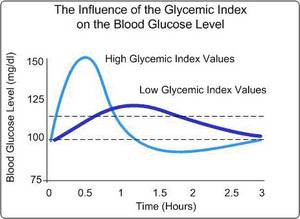
Eating food with a high glycaemic index (which means that the calories in it are released rapidly and used rapidly) produces a spike in the level of blood sugar, followed by a trough. Most people respond to the drop in blood sugar by eating again, probably something else that is high-GI. This is addictive behaviour.
This diagram from St John's Ambulance advice page on optimal nutrition for runners explains why:
If you are going for a run, then a high-GI spike may be good to give you the energy to get going; but it is not good if you are sitting at your desk. The aim of someone with a sedentary lifestyle should be to keep their blood sugar levels within the dotted lines on the graph, so as not to experience a trough which leads to eating high-GI food.
If you are addicted to tobacco, alcohol, drugs, etc., it is easier to remove yourself from environments where those things are available; and they are not necessary to life, unlike eating. Yes, one can switch to healthier eating, but that will probably only allow you to maintain weight; it is hard to lose weight by healthy eating alone.
The Weight Loss Resources site has a list of low GI foods.
The Weight Loss Resources site has a list of low GI foods.
Emotional stress
Most overeating is in response to emotional stress. I made a chart of my weight gains and losses over the years, and all of my overeating and subsequent weight gains were due to some trauma in my life. It is only by dealing with the underlying issues that I think I may have cracked it this time. (Only time will tell - but I am determined not to get so overweight again.)
Also, it can be a vicious circle - high weight leads to low self-esteem, so people self-medicate by eating more to make themselves feel better. That is not logical, but human emotions rarely are. This comment by Rickylicious on the Guardian article describes the vicious cycle of overeating and low self-esteem really well. Here's an excerpt; please do read the whole comment:
I hate being fat. I can't stop eating. I can't pull myself up by my bootstraps. I keep trying. I'm sick of being told by everyone I meet that I need to diet or exercise more. That much is self evident. Even to a stupid, ignorant fatty like me. I just get through each day as it comes as best I can. Then at the end of it all I eat, and eat again. Then I feel disgusted with myself. Worthless.The Lighter Life programme includes techniques from transactional analysis and cognitive behavioural therapy to help people to understand why they overeat, and develop other coping mechanisms for emotional trauma, feelings of emptiness, and unhappiness. Even so, I still struggle with the temptation to respond to any little feeling of stress with a binge. I am still learning to manage my new lower weight, as I have only recently finished Lighter Life.
Social pressure
Just about every social occasion involves some pressure to eat fattening foods, or drink highly calorific alcoholic drinks. "Oh go on, have another one, it can't hurt". We call these people "feeders". Often they are people who have never had an issue with weight themselves, and so just don't understand which foods are fattening and which are not. The pressure to eat fattening foods is immense, especially at weddings and family gatherings, Christmas, work outings, coffee with colleagues, and so on. And it's hard to go to the pub and have soda water, especially if there are people who insist on offering you alcohol and think you are some kind of Puritan if you decline (fortunately my friends don't do this).
Car culture
I now live in Oxford, one of the most cycling-friendly cities in the UK (and even then it's sometimes scary) which also has excellent public transport, and is small enough to walk from one place to another. However, if you live in London, which is downright dangerous to cycle in, then that's just not going to be a good place to get exercise, or if you live somewhere hilly, it's difficult to cycle up those hills when you first start trying to get fit. The culture of driving everywhere (and constructing roads and other infrastructure so you have to drive to out-of-town shopping centres) is surely a major contributor to the rise in obesity.
Unhealthy food
Healthy food is harder to obtain, and more expensive. So many foods are packed full of processed starch, sugar, and fat; vegetables are more expensive. When I was doing the candida diet, which cuts out sugar and yeast completely, I had to visit three different supermarkets to get the products I needed. Most products are full of sugar. Loads of things are labelled "low-fat" but hardly any are sugar-free. Unhealthy food is widely available. Restaurants have now started offering calorie-counted meals, which is helpful, but it is hard not to indulge in fattening things when everyone around you is doing so.
Other health issues
Many people are overweight or obese due to other conditions such as diabetes, thyroid conditions and so on. It is not well-understood how some people stay thin despite eating all sorts of fattening foods, whereas others only have to look at a biscuit to put on several pounds.
I am not diabetic or anything, but being obese caused me considerable joint pain, and my legs are still not straight as a result of this. Walking long distances is really painful when you are obese. Cycling and swimming are good because they do not put stress on the joints, but they are not available to everyone.
Exercise
Why are there more food shops than swimming pools? Why are gyms so expensive to join? Why do they play awful pounding music? What overweight or obese person would want to go to a gym full of skinny athletic people, when we are convinced they are looking down on us for being fat?
And the sheer awfulness of physical education in this country must be a major contributor to the lack of exercise of many overweight people. I hated PE at school - I have no hand-eye co-ordination so could not play ball games, I hated the picking of teams because I was always left till last (how humiliating), I was not very fit and already slightly podgy according to some (though I now know that I actually had a healthy BMI). I hated the competitive atmosphere, and the gendering of sport, and the way the bullies picked on me and my friends for being crap at sport, and were allowed to get away with it. Nowadays, I am told, there is the ritual humiliation of the bleep test, which is inflicted on pupils of PE, and sounds like a cruel and unusual punishment. I can honestly say that my experience of PE put me off all sport for decades. Nowadays I do yoga, cycling and swimming, but I do not see any of these as "sport".
Unhelpful comments
The self-righteous, unsympathetic and generally unhelpful comments from others, such as "Should you be eating that?" or "Every time I see you, you are eating" (yes, because it's lunchtime!) or suggestions on how to lose weight, or comments that obese people die earlier and have heart conditions and diabetes and stressed joints, or that losing weight is just a matter of will-power, or eating less and exercising more, are really really unhelpful.
The self-righteous, unsympathetic and generally unhelpful comments from others, such as "Should you be eating that?" or "Every time I see you, you are eating" (yes, because it's lunchtime!) or suggestions on how to lose weight, or comments that obese people die earlier and have heart conditions and diabetes and stressed joints, or that losing weight is just a matter of will-power, or eating less and exercising more, are really really unhelpful.
Do the people making these comments not think that the obese person spends a considerable portion of their day mentally beating themselves up for being obese? They do not need you to add to the chorus of internal self-criticism. It just makes avoidance of the issue more likely, because the response of the obese person is to think, sod you, you don't know how it feels to be me, you don't understand nutrition or diet or metabolism, and so avoid the issue by creating a defense mechanism around the whole issue.
People don't feel they have the right to comment on other behaviour or appearance issues, so why do they think they have a right to comment on people's weight? You should never comment on someone's weight unless they themselves ask your opinion. If you have never been overweight, you can't understand the vicious cycles involved.
On the other hand, when I was losing weight, it was nice to get positive feedback from people in the form of compliments on my new slim appearance. And many people approached it tactfully by saying, "You're looking well". As some people prefer not to get comments on their weight loss, this is probably a good idea if you don't know the person very well.
Personal choice
Nothing in this article is intended to be detrimental to people who are happy with their shape and size. If you are big and happy with it, good for you. It's completely rubbish that societal norms are geared towards being a stick-insect, and it's a fact that being underweight is more unhealthy than being obese.
I chose to lose weight because I found it physically painful carrying around the extra weight, and because I am genderqueer, I didn't like being curvy and buxom.
I chose to lose weight because I found it physically painful carrying around the extra weight, and because I am genderqueer, I didn't like being curvy and buxom.
Thursday, February 14, 2013
An interesting conversation
I had an interesting conversation the other day. I got chatting to a woman in a shop, and the conversation ranged over a number of topics, until it settled on same-sex marriage.
So this woman had loads of gay friends (so she said), and she was OK with civil partnerships, and yet she was opposed to same-sex marriage. Her reason was "but it says in the Bible..."
So I said, "But what about David and Jonathan? The Bible says that David's love for Jonathan surpassed his love for women". Oh yes, said the woman.
Then I said, "And what about Ruth and Naomi? The vow that Ruth made to Naomi is used in wedding ceremonies." And I talked about how amazing Ruth's love for Naomi was, that she was prepared to go to another country and risk being sold into slavery because she loved her so much. (Thanks to Kittredge Cherry for wising me up to the story of Ruth and Naomi.)
And then I said, "God is Love, right? And LGBT people love each other, so that must be godly."
And it seemed that I had succeeded in changing her mind.
Now, if I had called her a "bigot" at the outset of the conversation, that would have been it - end of conversation. And I don't think she was a bigot; she wanted to understand, and she seemed genuinely pleased to be offered a different interpretation of the Bible.
So, be careful before you jump to calling someone a bigot before you have found out what their real views are, under a possibly very thin veneer of religious conformity.
Also, it helps if you know how to do liberal Biblical interpretation.
Wednesday, January 16, 2013
Adjectives, not nouns
The trans* community are not the only ones to point out that "transsexual" is not a noun, it's an adjective. There are many other groups who have made the same point. It's rude to refer to someone as "a dyslexic", "a spastic", "a gay", "a black", "a Chinese", "a Malay", "a ginger".
Why is that? Well, for one thing, the characteristic being referred to is not the only significant thing about them; it's not a defining characteristic. They may also write poetry, drive a vehicle, tap-dance, sing, be a great lover, and so on.
There are plenty of alternatives to using these adjectives as nouns. A transsexual person (who could be male or female - the term transsexual does not signify gender); a gay person; a person with ginger hair / a ginger-haired person; a person with dyslexia / a dyslexic person; a person with cerebral palsy; a Black person; a person of colour; a Chinese person; a Malaysian person. Of course, their ethnicity is only relevant in the context of a conversation about ethnicity. (Though several Black people have pointed out recently that the whole colour-blindness trope is actually really unhelpful and assimilationist.)
Tuesday, January 15, 2013
Structural inequality of an invisible minority
I am part of a persecuted minority. OK, we are not very persecuted (people don't refuse us mortgages, or call for us to be executed, and we are allowed to get married), but we are persecuted, and our inequality is built into the environment - especially in America. Like people with ginger hair, we are regarded as legitimate targets for abuse.
What group am I referring to? Left-handed people.
In America, there's an epidemic of right-handed desk-chairs. Whenever I have had to sit at one of these, I either get two and flip the desk of the other one over so I can have it on my left, or just use it as a normal chair, because it is completely useless as a desk. However, right-handed desks are only the most extreme example of the environment being structured for right-handed people. Cameras are right-handed, scissors are right-handed (and are really painful for a left-handed person to use because the grips are sculpted for right-handed use, and the blades are the wrong way round), musical instruments and sporting bats, clubs etc are made for right-handed use. Computer mice are set by default for right-handed use, and often sculpted to cup nicely into the palm of your right hand. Bread knives, cake forks, kitchen knives - they are all made for optimum use by right-handed people (because the blades are sharp only on one side). When I was at school (admittedly over 30 years ago; things may have got better now), a teacher gave up trying to teach me to sew because I started a seam at the "wrong" end.
If you are right-handed, you are probably completely unaware of these issues. The world is quite literally structured to fit your grasp. You're probably thinking right now that I am just whingeing, and I could adapt to the right-handed environment (after all, it's not that hard), or buy left-handed implements (which, incidentally, are more expensive because they are produced in smaller numbers - and once you've learnt to compensate for the blades being the wrong way round on right-handed scissors, it's hard to cut straight with left-handed ones). Well folks, that's privilege, and being completely unaware of your privilege.
I bet you use words like "cack-handed", "gauche", "sinister" (or if you are Spanish, zurdo, which means clumsy or left-handed) -- all of which are insults meaning "left-handed". Even the word "left" means "surplus to requirements". in English, there are no less than seventeen different dialect words for left-handed, all of which mean "the hand you wipe your arse with" (including "cack-handed", which is regarded as a synonym for clumsy). People used to say stuff like "oh it looks weird when you do stuff with your left hand - it's all cack-handed".
I am raising this issue, not to claim equality with other forms of persecution and exclusion (after all, left-handed people are not in danger of our lives), but to point out that, unless you bump up against it every day of your life (as disabled people, minority ethnic people, LGBT people do every day), structural inequality is largely invisible - because you take the way the world fits your hand like a glove completely and utterly for granted.
Wednesday, December 12, 2012
We are rising!
No-one outside Paganism seems to have noticed that the number of out and proud Pagans has doubled since the last census.
Census 2011
Animism 541
Occult 502
Druid 4,189
Heathen 1,958
Pagan 56,620
Pantheism 2,216
Reconstructionist 251
Shamanism 650
Thelemite 184
Wicca 11,766
Witchcraft 1,276
______________________
Total = 80,153
Not included in the above total: Traditional African Religion 588, Vodun 208, Taoism 4144, Shinto, 1075, New Age 698, Native American Church 127, Chinese Religion 182, Satanists 1,893.
Here's the Office of National Statistics page with the spreadsheets if you want to download a copy and play with the numbers yourself.
Census 2001
Pagan 30,569
Wiccan 7,227
Druid 1,657
Pantheist 1,603
Heathen 278
Asatru 92
Animism 401
Ancestor Worship 101
Celtic Pagan 508
______________________
Total 42,436
Tuesday, December 11, 2012
The complexity of marriage law - update
Legal (permitted by law and recognised by the state):
Being made legal soon:
Not forbidden by law, but not recognised by the state
- Opposite-sex church weddings (couple legally married and registered)
- Same-sex civil partnerships in a register office / registered premises for weddings
- Opposite-sex marriages in a register office / registered premises for weddings
- Religious civil partnerships (civil partnership ceremonies in a religious building)
- Same-sex weddings in register offices and those churches & synagogues that want to do them (couple legally married and registered)
- A transsexual person married to a person of the opposite sex to their original sex wanting to change their birth certificate to reflect their new sex will no longer have to divorce their partner (because when same sex marriage is legal, they can stay married).
- A transsexual person civilly partnered to a person of the same sex will be able to change / "upgrade" to a marriage (8.5 on page 27 of the consultation outcome document)
- Pagan same-sex handfastings in Scotland
The new arrangements for trans people are still not very satisfactory, as the conversion from one type of legal recognition to another will cost them money. This is particularly annoying for people who have already had to change their relationship status under the previous arrangements.
- same-sex blessings in a church / synagogue
- Pagan handfastings (weddings) in England & Wales
- Blessings of polyamorous relationships
- Humanist weddings - both same and opposite sex
- Opposite-sex civil partnerships in a register office / registered premises for weddings
- Marrying more than one person
Legal (permitted by law and recognised by the state) in Scotland only:
- Pagan opposite-sex handfastings where the celebrant says the required form of words (the same as for all other legal weddings)
Subscribe to:
Posts (Atom)